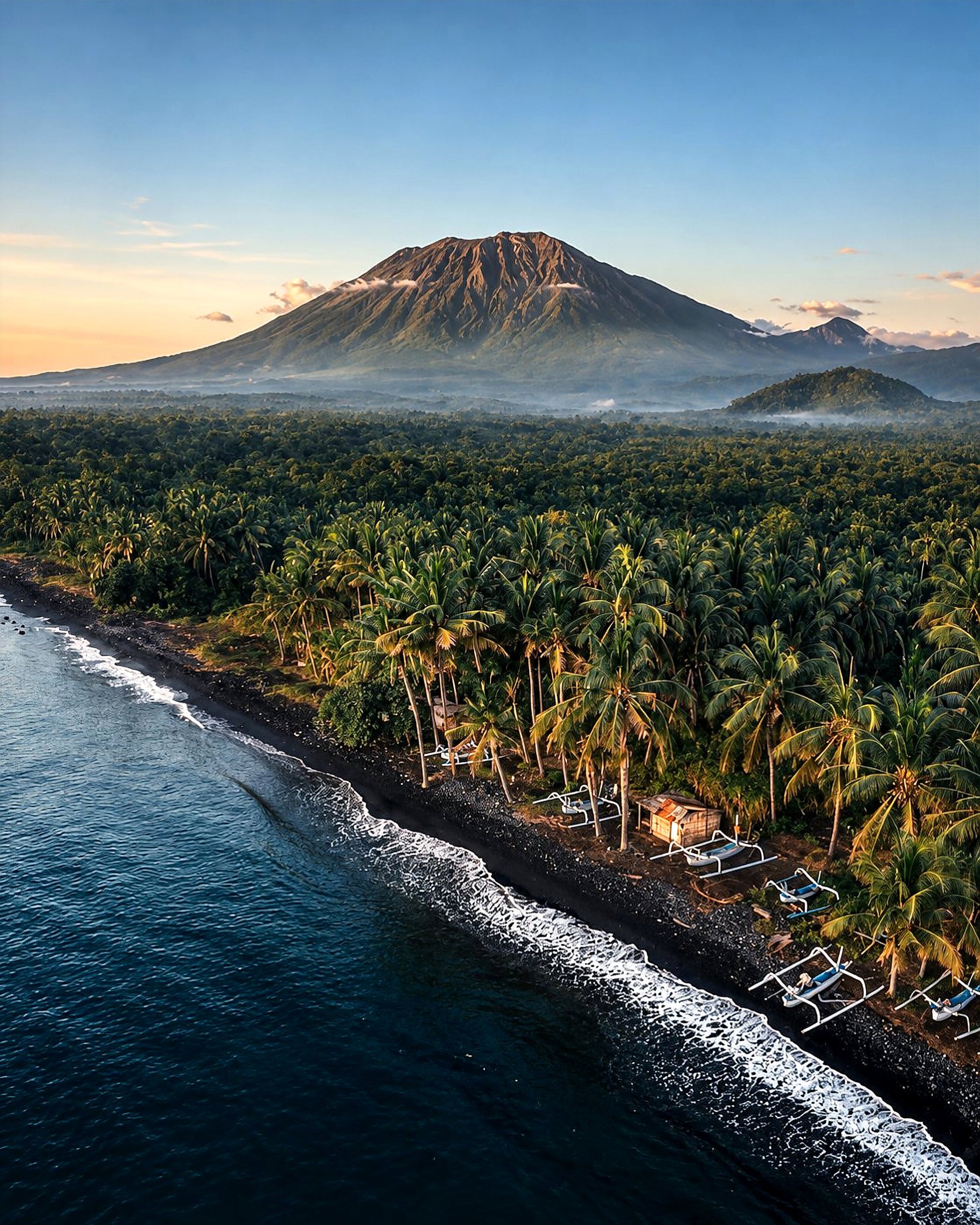
Gunung Agung is Bali's highest mountain and its holiest: the seat of the gods above Pura Besakih, and a volcano that killed more than a thousand people in 1963 and erupted again from 2017 to 2019. You can climb it, but only with a local guide, only when the temples allow it, and only if you are ready for a long, steep night on loose rock.
Can you climb Mount Agung right now?
Usually yes, with a licensed local guide, but check two things before you book: the alert level and the temple calendar. Indonesia's volcano agency (PVMBG) reported Agung at Level I, Normal, in mid-August 2026. Even then it asks visitors to avoid the crater in cloud or rain and never to camp near it or descend into it. Check the live level on MAGMA Indonesia before you climb, since it can change within days.
The mountain also closes during major ceremonies at Pura Besakih and Pura Pasar Agung, and in extreme weather. In 2026 it closed from 28 March to 24 April for the great rites at Pura Agung Besakih, and from 26 June to 2 July for the Aci Purnama Kasa ceremony at Pura Pengubengan, where the summit route begins. Closures are announced by the temple communities, often only days or weeks ahead; a good guide will know before you do.
Pasar Agung or Besakih: which route?
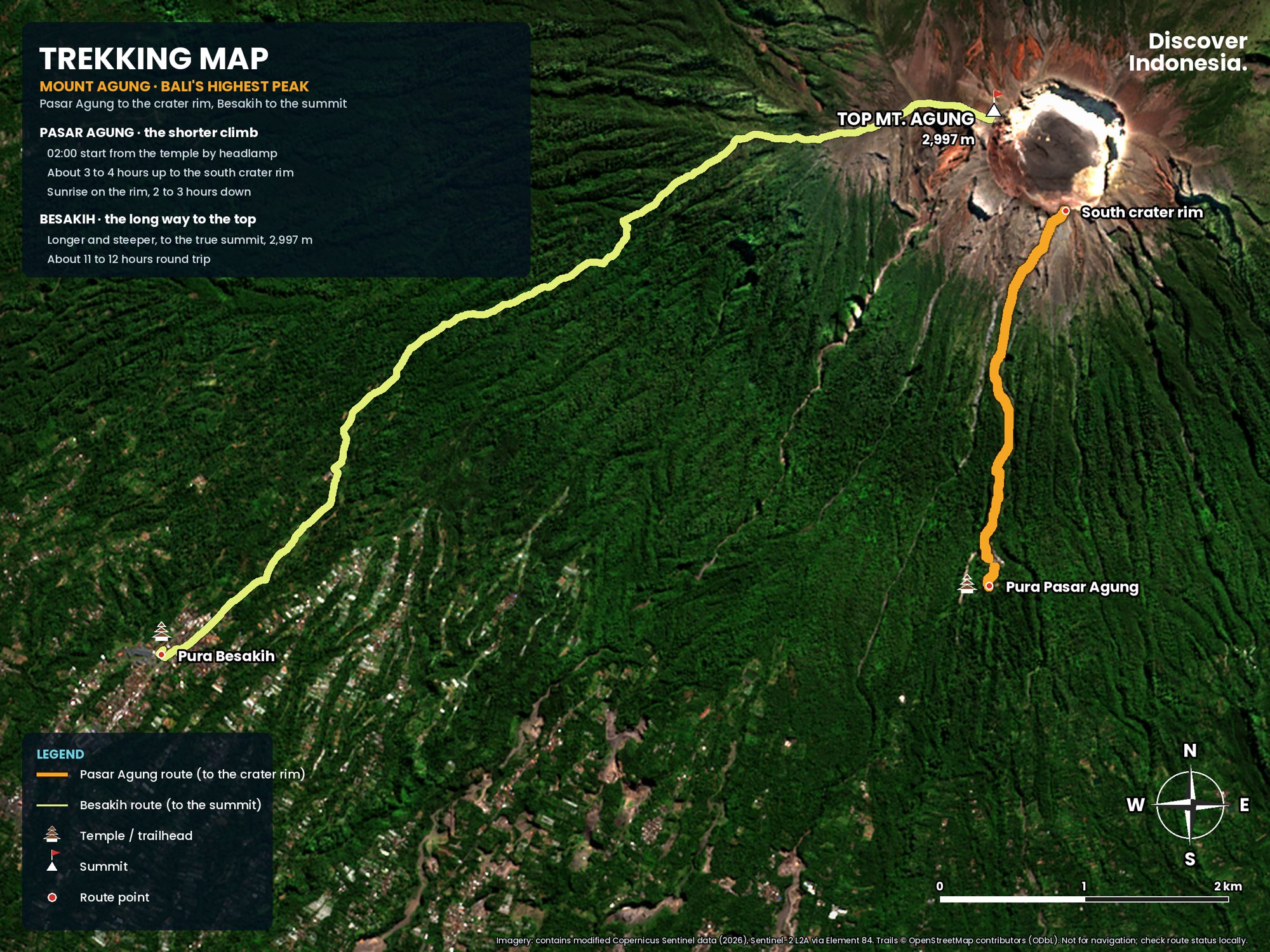
Most people climb from Pura Pasar Agung, which starts higher, takes three to four hours up and ends on the south crater rim at roughly 2,866 m. Choose Besakih if you want the true summit, at about 3,000 metres on the western side, and can handle a much longer day. Both start in the middle of the night so you reach the top for sunrise.
| Pasar Agung route | Besakih route | |
|---|---|---|
| Start | Pura Pasar Agung, about 1,600 m, near Selat | Above Pura Besakih near Pura Pengubengan, about 1,150 to 1,200 m |
| Goal | South crater rim, about 2,866 m | True summit, about 3,000 m |
| Height gain | About 1,300 m | About 1,800 to 1,900 m |
| Time up | 3 to 4 hours | 6 to 7 hours |
| Time down | 2 to 4 hours | 5 to 6 hours |
| Typical start | Around 2 a.m. | Around midnight |
Pasar Agung. From the car park, 297 steps lead up to the temple, where guides wait. The first hour climbs steeply through forest on a rooted path; above the tree line come slabs and loose gravel, and the last third to the rim is slow, steep and often on all fours. At about 2,425 m a faint, exposed path splits off towards the true summit, for confident scramblers with a guide who knows it only. Most groups watch sunrise on the rim and look down into the crater, its floor dark with the new lava of 2017 to 2019.
Besakih. This route climbs the southwest ridge from the last temples above Besakih. The first hours are in dense forest, steep and muddy after rain; above about 2,200 m the path turns stony and loose, and the final stretch follows a narrow ridge with steep drops on either side, where strong winds can make it dangerous to continue. The reward is the only full 360-degree view on the mountain. Plan on 11 to 12 hours in total.
How hard is it, and do you need a guide?
Very hard for a one-night hike: far steeper and longer than the Mount Batur sunrise trek, with relentless climbing, loose scree and scrambling near the top. You need no technical skills, but you do need solid fitness, good balance and a willingness to turn back. What catches people out is the descent, where loose gravel and ash over hard rock meet tired legs. Trekking poles help a great deal.
A licensed local guide is mandatory. A January 2025 circular from Bali's Forestry and Environment Service requires climbers to use local guides and follow staff at the climbing posts; a Norwegian tourist who climbed alone the following month was caught and deported. That same January a Korean climber died on Agung, and the province barred climbing in extreme weather. Do not climb in rain or high wind, and do not leave the trail at the rim.
When is the best time to climb Mount Agung?
The dry season, roughly April or May to October, gives the best chance of a clear sunrise and safe footing; August is usually the driest month. Avoid November to March, when wet rock and ash are treacherous and cloud often hides the view. From June to September strong gusts can sweep the upper ridge, and guides sometimes turn back before the top.
Closures complicate the calendar. The Ida Bhatara Turun Kabeh ceremony at Pura Besakih runs for 21 days from the full moon of the tenth Balinese month, in March or April, and the mountain usually closes for about four weeks around it: 6 April to 3 May in 2025, 28 March to 24 April in 2026. May, September and early October are often the sweet spot. If your dates are fixed, keep Mount Batur as a fallback; it stayed open during the 2026 closure.
What do you see from the top?
At first light you look east across the Lombok Strait to Mount Rinjani, often standing clear above a sea of cloud. To the northwest lie the Batur caldera and its lake; to the south, Nusa Penida, Nusa Lembongan and the lights of the southern coast. Within an hour of sunrise cloud often covers the lower slopes, so take your photos early. If Rinjani tempts you next, see our guide to climbing Mount Rinjani.
Getting there and where to stay
Allow about two hours by car from Canggu, Seminyak, Kuta or Sanur, and an hour and a half from Ubud. Both trailheads are in Karangasem regency in east Bali, and for a 2 a.m. start at Pasar Agung, pickups in the south are usually around 11 p.m. There is no useful public transport at night, and a scooter on these steep, dark roads is not a good idea. Better still, sleep close by: Sidemen suits Pasar Agung, and Besakih's simple homestays are minutes from the summit route.
What to bring, and how to behave
Bring warm layers, a windproof shell, hat and gloves for the rim before dawn; hiking shoes with good grip; a strong headlamp; trekking poles; at least 2 litres of water, more for Besakih, since there is no reliable water on the mountain; a rain jacket and sunscreen; your passport or a copy; and insurance that covers hiking at this altitude.
For Balinese Hindus, Agung is the dwelling place of the gods, so treat the climb as a temple visit. Dress modestly, keep your voice down near shrines, never step or sit on offerings, and carry out all your rubbish. Inappropriate photos and littering on sacred peaks are what triggered the 2023 ban. If the mountain is closed, accept it; climbing during a closure can end in deportation.
Quick answers
How high is Mount Agung?
About 3,000 metres. The Smithsonian lists 2,997 m, other modern surveys give 3,031 m, and older maps still quote 3,142 m. It is the highest point on Bali.
When did Mount Agung last erupt?
From 2017 to 2019, closing Bali's airport in late November 2017; the Smithsonian records the last eruption of that episode on 13 June 2019. The 1963 eruption killed between 1,100 and 1,900 people. More on our Mount Agung volcano page.
Is climbing Agung banned?
No. Bali's governor announced a ban on tourist activity on 22 mountains in May 2023, but guided climbs of Agung have continued; the focus is now on mandatory guides and weather and ceremony closures.
Is it worth visiting Pura Besakih too?
Yes. Bali's mother temple, a complex of 23 temples on Agung's southwest slope, explains why the mountain matters. Come early, wear a sarong and buy your ticket at the official counter; you do not have to pay unofficial "guides" or extra levies.
Our Discover Indonesia: Mount Agung guide and our Bali guides cover the routes, itineraries and places to stay in more depth. Browse them all on our guides page.
Facts checked October 2026. Alert levels, ceremony closures and climbing rules change often and sometimes at short notice; confirm with a licensed local guide, MAGMA Indonesia (PVMBG) and Bali's Forestry and Environment Service before you climb.
- Agung (Smithsonian Global Volcanism Program)
- Gunung Agung Masih Level Normal (BaliNews.id, August 2026)
- Bali's Mount Agung Will Be Closed To Tourist Hikers (The Bali Sun, March 2026)
- Mount Agung in Bali to remain closed for 28 days (Travel Trade Journal, March 2026)
- Pendakian Gunung Agung Ditutup Sepekan, 26 Juni hingga 2 Juli 2026 (Mounture)
- Mount Agung Closed for Sacred Ceremony at Pura Besakih (Bali Live, 2025)
- Pendakian Gunung Agung ditutup sementara karena upacara agama (Antara Bali, 2024)
- Pemprov Bali larang mendaki Gunung Agung selama cuaca ekstrem (Antara Bali, January 2025)
- Pendaki Gunung Agung Wajib Pakai Pemandu Lokal (detikBali, January 2025)
- Norwegian tourist deported from Bali for violating Mount Agung hiking rules (ScandAsia, 2025)
- Bali Bans Tourist Activities on Mountains (Tempo, 2023)
- Thousands stranded as Bali airport closes (Arab News, 2017)
- Gunung Agung (Gunung Bagging)
- Besakih Temple (Wikipedia)
- Mount Agung (Wikipedia)