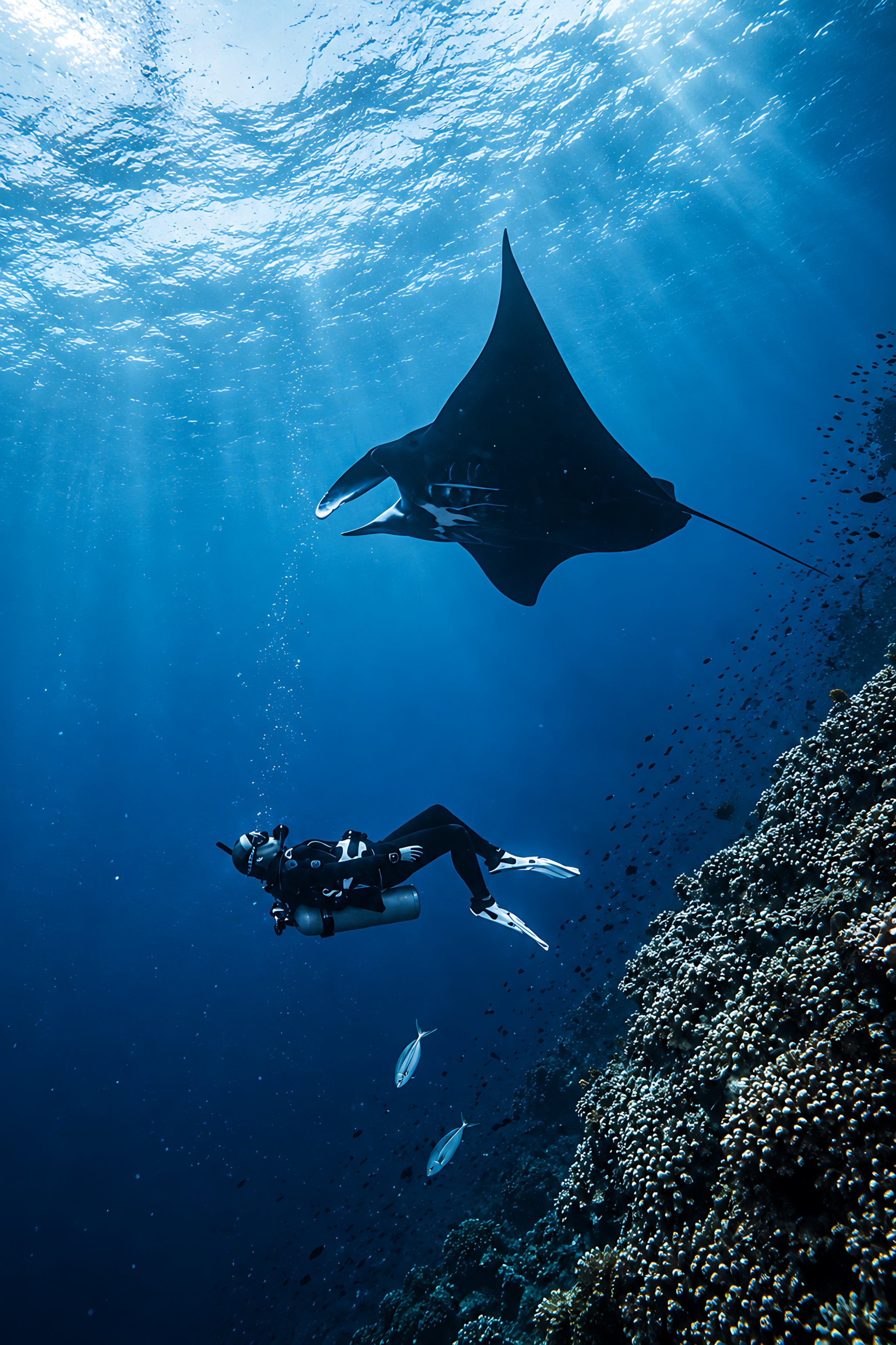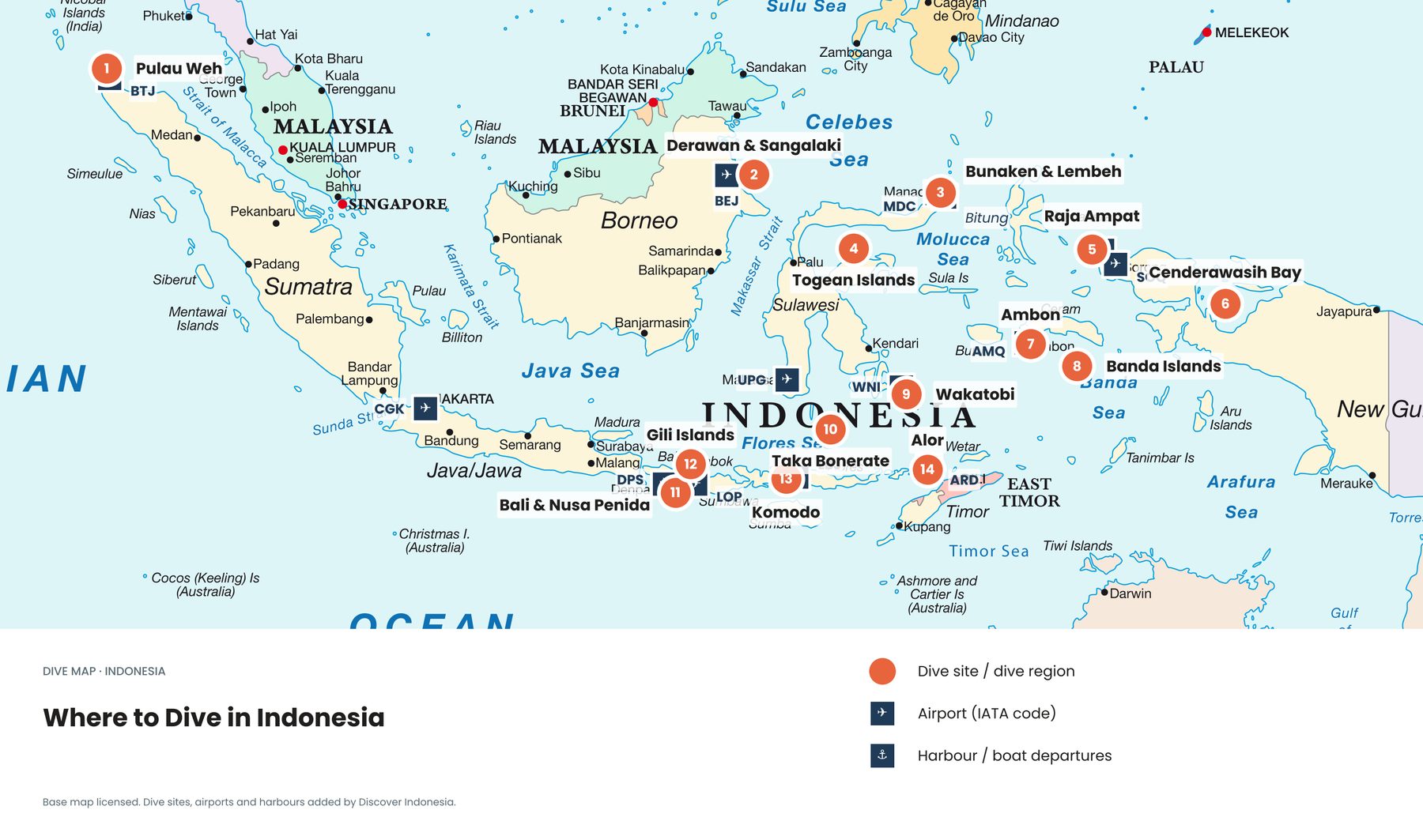
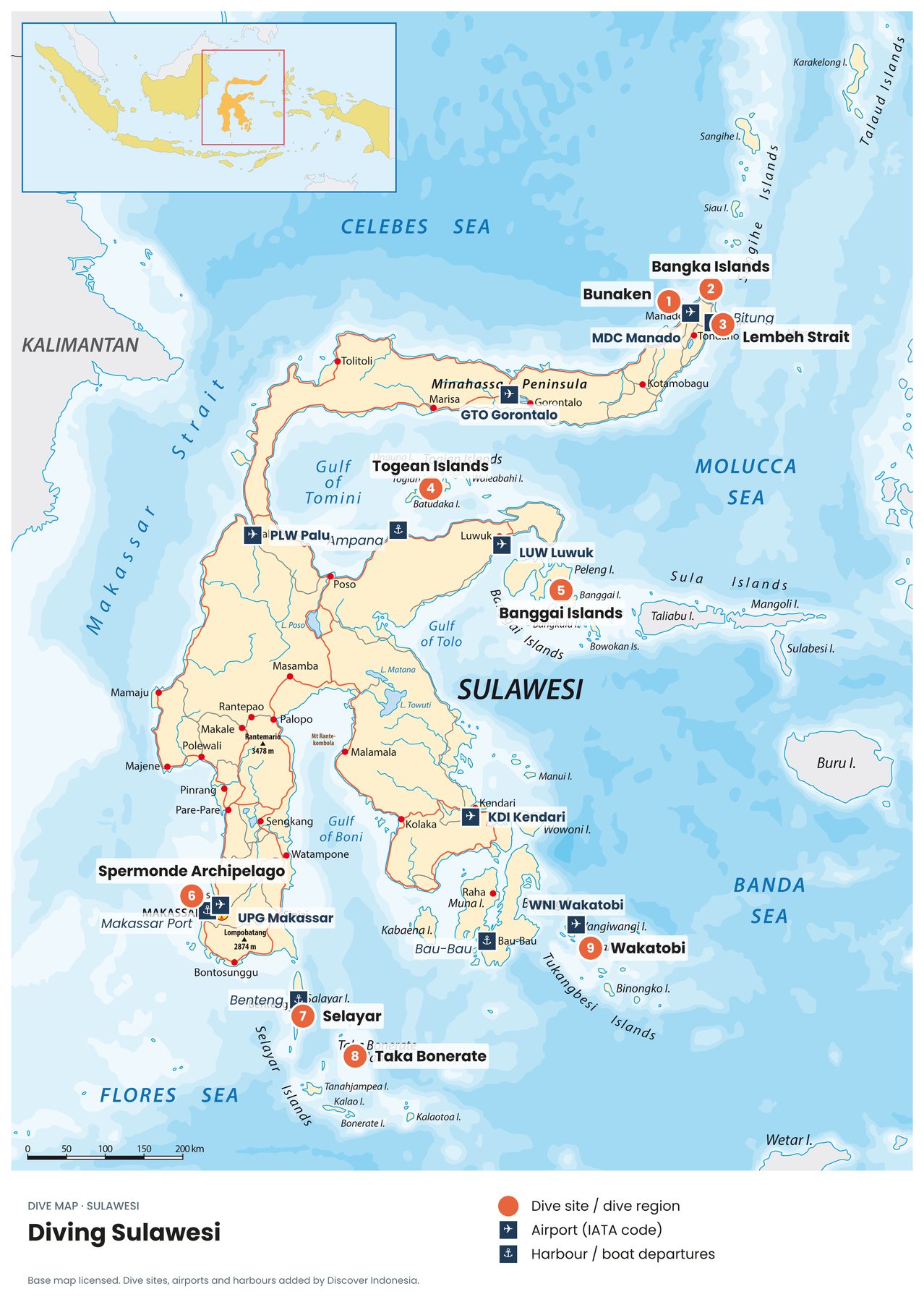
Sulawesi is shaped like no other island, four long arms reaching into four different seas. Each arm has its own diving, from the walls of Bunaken in the north to the atolls of Taka Bonerate and the reefs of Wakatobi in the south. This is how the regions compare, and how to reach them.
Where is the best diving in Sulawesi?
It depends on what you want. North Sulawesi has the easiest access and the most famous names: Bunaken for walls and Lembeh for critters. The southeast has Wakatobi, with some of the healthiest reefs in Indonesia. The remote centre and south, the Togean Islands, Banggai and Taka Bonerate, reward divers who are willing to travel slowly.
Sulawesi sits in the middle of the Coral Triangle, between the Celebes, Molucca, Banda and Flores seas, so the diving changes completely from one arm to the next. Overland travel between the arms takes days, so most divers pick one region, or two linked by a flight. For the wider context, see where to see the Coral Triangle.
North Sulawesi: Bunaken, Bangka and Lembeh
The northern arm is the best developed dive region on the island, with dozens of resorts and a busy international airport at Manado, and three styles of diving within a few hours of it.
- BunakenCoral walls and turtles in a national park just off Manado. Declared a national park in 1991, it protects five islands and is about 45 minutes from the city by boat.
- Bangka IslandsSoft-coral pinnacles at Sulawesi's northern tip, often with current and schooling fish. Better once you are comfortable with drift dives.
- Lembeh StraitThe world's muck-diving capital, near Bitung: a channel about 16 kilometres long where frogfish, mimic octopus and flamboyant cuttlefish live on dark volcanic sand. North Sulawesi dive guide →
A week here usually splits into a few days on the walls and a few in Lembeh. Our North Sulawesi guide covers the sites, the Bunaken park fee, transfers and where to stay.
What are the Togean Islands like for diving?
- Togean IslandsRemote islands in the calm Gulf of Tomini, with reefs, lagoons and simple beach bungalows. Reached via Ampana.
The Togean Islands are a scattered group of 56 islands and many islets in the Gulf of Tomini, off Central Sulawesi, protected as a national park since 2004. They are known for quiet reefs, mangroves and lagoons, simple beach bungalows with small dive centres attached, and very few other divers. The park holds around 132,000 hectares of coral reef, one of its villages is home to the Bajau, and on land live the Togian babirusa and two birds known only from here, the Togian hawk-owl and the Togian white-eye.
Why is the Banggai cardinalfish special?
- Banggai IslandsHome of the Banggai cardinalfish, a striking little fish found naturally only around these islands. Luwuk (LUW) is the nearest airport.
The Banggai cardinalfish is a small silver-and-black striped fish that lives naturally only around the Banggai Islands, off the eastern arm of Central Sulawesi. It is listed as Endangered by the IUCN, mainly because of collection for the aquarium trade. Its range is tiny because of how it breeds: the male carries up to about 90 eggs in his mouth for as long as 30 days, and the young are released as miniature adults, with no drifting larval stage to spread them to new reefs.
It lives in very shallow water, typically 1.5 to 2.5 metres deep, among the spines of long-spined sea urchins, in anemones, branching corals and seagrass, which makes it a snorkelling animal as much as a diving one. Look but don't chase: groups scatter into the urchins, and the spines hurt. Since 2018 catching it in the Banggai waters has been banned in its peak spawning months of February, March, October and November.
South Sulawesi: Spermonde, Selayar and Taka Bonerate
The southern arm centres on Makassar, the largest city on the island and its main southern air hub. Close to the city the diving is casual; further south, it becomes some of the most remote in Indonesia.
- Spermonde ArchipelagoDozens of small islands off Makassar, easy to reach on a day trip from the city. In all there are about 120 islands and sand cays, roughly 50 of them inhabited.
- SelayarA long island south of Sulawesi's southern arm, and the gateway to Taka Bonerate. It is over 80 kilometres long, and Benteng, its main town, is where dive trips start.
- Taka BonerateOne of the largest atolls in the world, in the Flores Sea. Taka Bonerate dive guide →
Spermonde suits divers with a day or two in Makassar, not a dedicated dive trip: reef condition on these busy, inhabited islands varies a lot, so ask operators which reefs are in good shape. Taka Bonerate is the opposite, a national park since 1992 with near-empty sites and long, unhurried dives. From Makassar you travel by road and ferry to Selayar, or check for flights, then charter a boat from Benteng for about four hours to Tinabo. Many divers simply join a liveaboard.
Southeast Sulawesi: is Wakatobi worth the trip?
- WakatobiA national park of four islands with some of Indonesia's healthiest reefs. Wakatobi dive guide →
For many experienced divers, yes. Wakatobi National Park covers the Tukang Besi Archipelago off Sulawesi's southeastern tip, about 1.39 million hectares, almost all of it sea, and has been a UNESCO biosphere reserve since 2012. The name comes from the four main islands: Wangi-Wangi, Kaledupa, Tomia and Binongko. Expect walls, reef slopes, atolls and very good snorkelling straight from the shore.
Wangi-Wangi has the Matahora airport (WNI), with flights from elsewhere in Sulawesi (check current routes), and ferries also run from Kendari and Bau-Bau. Tomia and Hoga are popular dive bases; Wangi-Wangi has the most guesthouses and the best connections.
When is the best time to dive Sulawesi?
Diving is possible all year in most regions, but conditions vary because the arms face different seas. In the north, the drier months from roughly April to October bring the calmest seas and best visibility at Bunaken, while December to February is wetter and rougher. In the remote south and centre, sea conditions decide whether boats run at all: ask the dive operator or liveaboard which months they run trips, and trust that over any general calendar.
Which Sulawesi dive region is right for you?
| Region | Best for | Access | Effort |
|---|---|---|---|
| Bunaken and Bangka | Walls, turtles, soft-coral pinnacles | Fly to Manado (MDC), then boat | Easy |
| Lembeh Strait | Macro and critter photography | Manado, road to Bitung, short boat | Easy |
| Togean Islands | Quiet reefs, island life, low cost | Fly to Palu, Gorontalo or Luwuk, then ferry | High |
| Banggai Islands | Banggai cardinalfish in the wild | Fly to Luwuk (LUW), then boat | High |
| Spermonde | A dive day from Makassar | Boat from Makassar | Easy |
| Selayar and Taka Bonerate | Remote atoll diving | Road and ferry via Selayar, or liveaboard | High |
| Wakatobi | Healthy reefs, walls, snorkelling | Fly to Wangi-Wangi (WNI) or ferry | Medium |
Pick one end of the island and fly between Manado and Makassar rather than travelling overland. Allow buffer time for the Togean Islands, Banggai and Wakatobi, where boats and flights don't always connect, and bring cash and spare parts, as ATMs are scarce and dive shops small. Bunaken, the Togean Islands, Taka Bonerate and Wakatobi all charge national park fees; check current rates locally.
Quick answers
Where should I start on a first Sulawesi dive trip?
In the north. Bunaken and Lembeh have the easiest logistics and the widest choice of resorts and dive centres.
How do you get to the Togean Islands?
Fly to Palu, Gorontalo or Luwuk, travel to Ampana (or start from Gorontalo), then take a ferry to Wakai. Public ferries run only about twice a week, so many travellers use speedboats or chartered boats, and spare days are essential.
Can you see Banggai cardinalfish in Lembeh?
Yes. Released aquarium fish have founded populations outside the natural range, including in the Lembeh Strait, but the Banggai fish are the genetically original stock.
How big is Taka Bonerate?
About 220,000 hectares, the largest atoll in Southeast Asia and, by most counts, the third largest in the world, with 21 islands.
For how Sulawesi fits into the rest of the country, read our overview of diving in Indonesia. Our Discover Indonesia guides to Sulawesi, Wakatobi and Taka Bonerate cover the island in more depth; see all our guides.
Facts checked October 2026. Ferry schedules, flights and park fees in Sulawesi change often; confirm with the national park offices and your dive operator before you travel.
- Bunaken National Park (Wikipedia)
- The Lembeh Strait (Indonesia Travel, Ministry of Tourism)
- Togian Islands (Wikipedia)
- Banggai cardinalfish (Wikipedia, citing IUCN 2025)
- Keputusan Menteri Kelautan dan Perikanan No. 49/2018 (Ministry of Marine Affairs and Fisheries)
- Menjaga ikan endemik dari perairan Banggai (Mongabay Indonesia, 2022)
- Spermonde Archipelago (Wikipedia)
- Selayar Island (Wikipedia)
- Taka Bonerate National Park (Wikipedia)
- Taka Bonerate–Kepulauan Selayar Biosphere Reserve (UNESCO)
- Wakatobi Biosphere Reserve (UNESCO)
- Wakatobi National Park (Wikipedia)