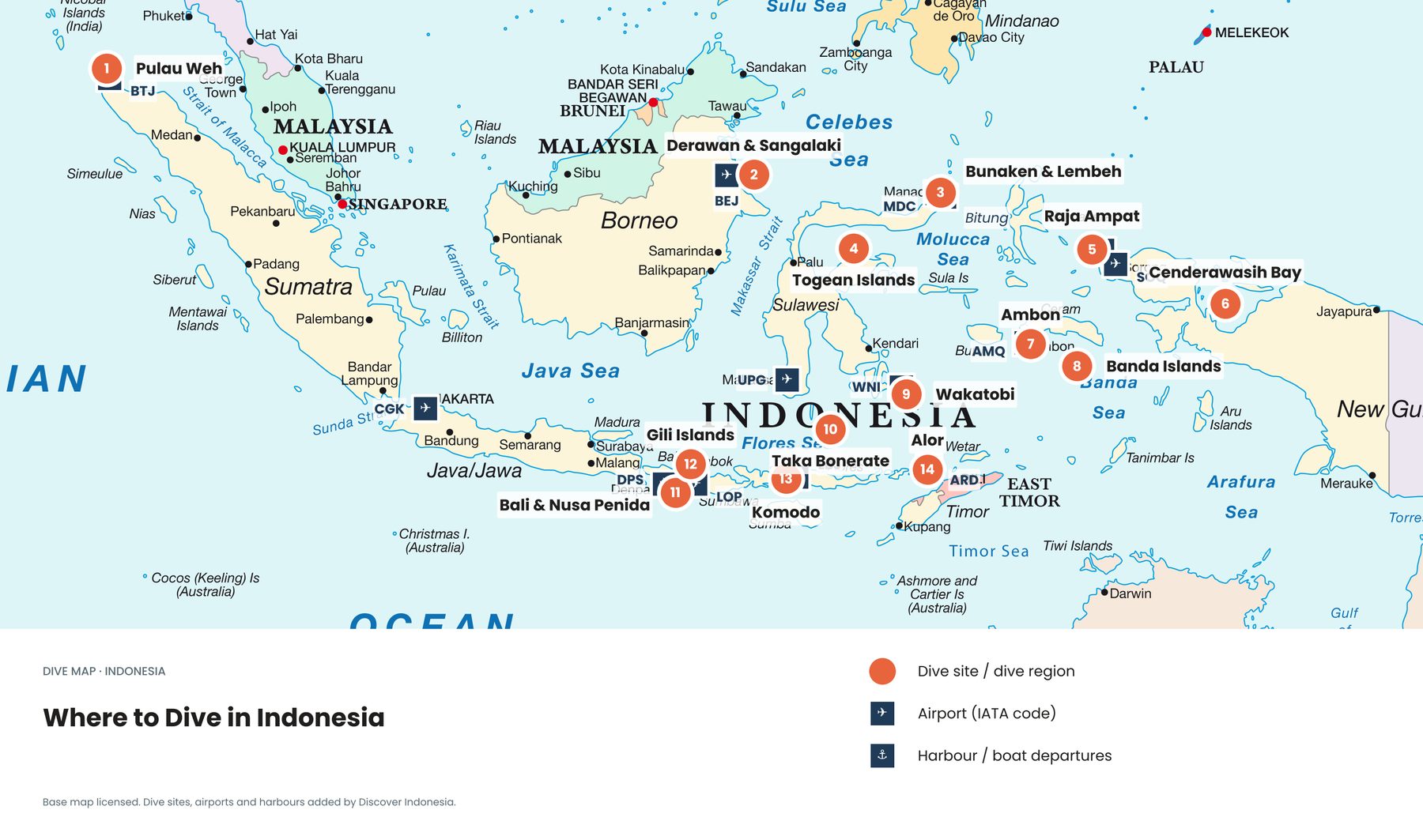
East of Java, a chain of islands runs for more than 1,000 kilometres: Bali, Lombok, Sumbawa, Flores, and on to Alor. Together they're called the Lesser Sunda Islands, and between every pair of them lies a strait full of current and life. This is the whole route, region by region, with when to go and how to get there.
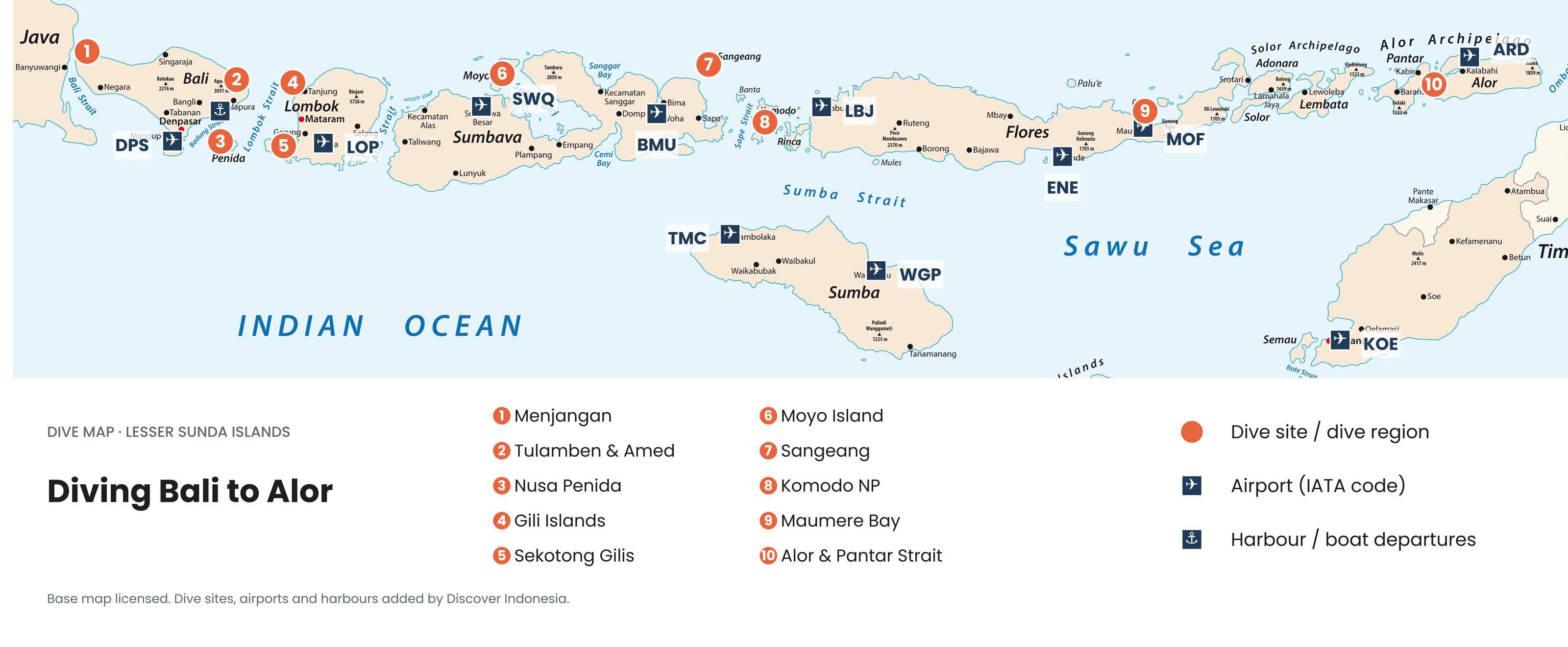
Few dive trips in the world line up as neatly as this one. Travel west to east and the diving changes from easy beach dives in Bali to some of the most current-swept pinnacles in Asia, with turtles, mantas, volcanoes and muck sites along the way.
The ten regions, west to east
- Menjangan, BaliCalm walls inside West Bali National Park, reached by a short boat ride from the Bali coast. Usually good visibility and gentle conditions. Bali dive guide →
- Tulamben & Amed, BaliThe USAT Liberty wreck and easy reefs from the beach. The Liberty was torpedoed in 1942, beached here, and pushed into the sea by Mount Agung's 1963 eruption.
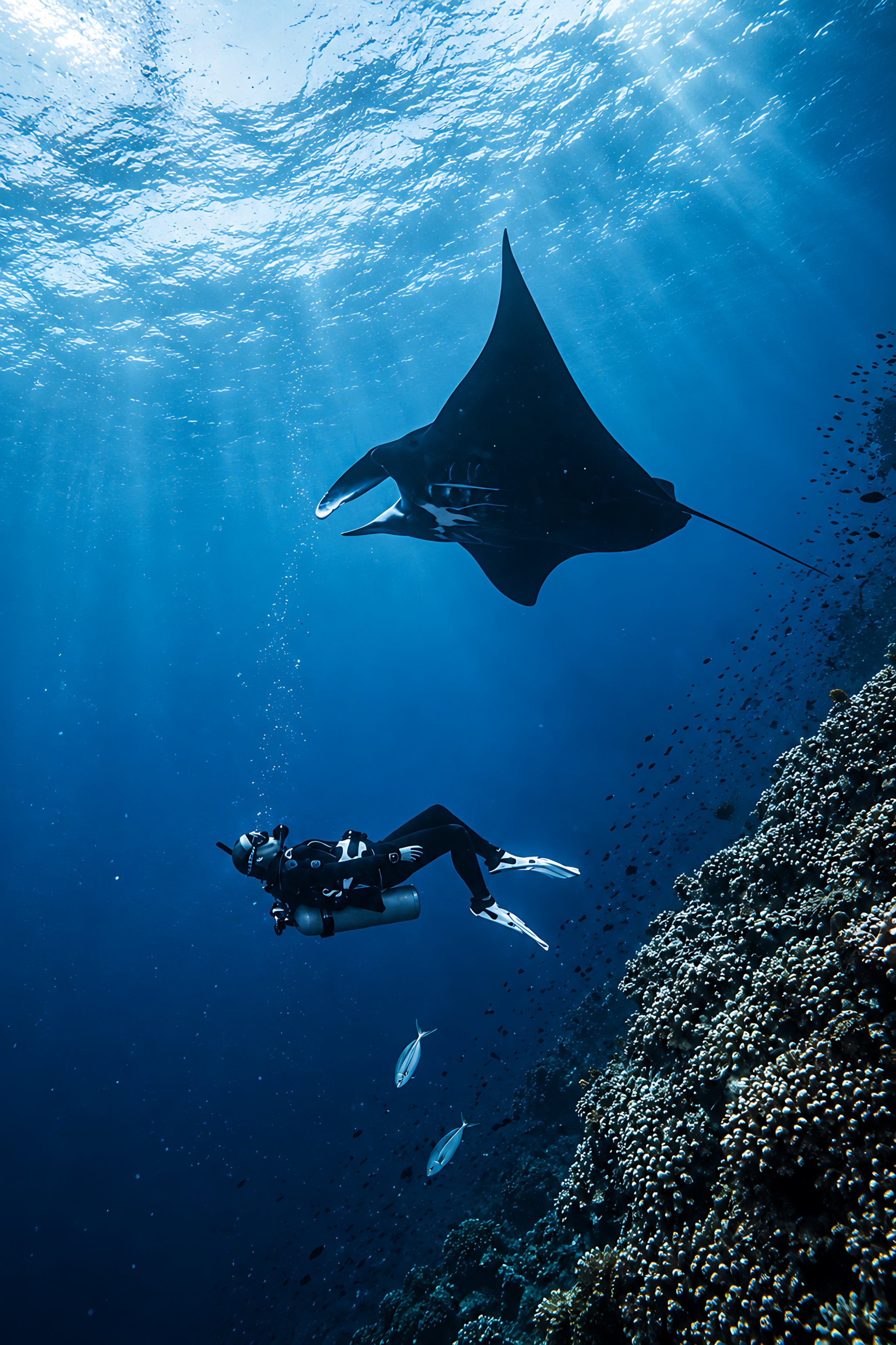
- Nusa Penida, BaliManta rays year-round and mola mola in season, usually July to October, in strong, cold currents fed by the Lombok Strait.
- Gili Islands, LombokTurtles, easy dives and a relaxed island scene. A popular place to learn, inside the protected Gili Matra marine park.
- Sekotong Gilis, LombokThe quieter small islands off southwest Lombok, sold on boat trips as the "Secret Gilis", with calm reefs and few visitors.
- Moyo Island, SumbawaA protected island off Sumbawa's north coast, with reefs and walls around its shores and forest and waterfalls inland.
- SangeangAn active volcano rising from the sea between Sumbawa and Komodo. Black sand and volcanic reefs. Mostly visited by liveaboards, and only when the volcano allows.
- Komodo National ParkCurrents, mantas and some of the richest reefs in the world. Komodo dive guide →
- Maumere Bay, FloresReefs on the north coast of Flores, once famous, then badly damaged by the 1992 earthquake and tsunami and by destructive fishing.
- Alor & the Pantar StraitCold, clear water and powerful currents at the eastern end of the chain. Alor dive guide →
Why are there strong currents between the Lesser Sunda Islands?
Because the islands form a wall between the Pacific-fed seas of Indonesia and the Indian Ocean, and water has to squeeze through the gaps. The Lombok Strait between Bali and Lombok, the Sape Strait between Sumbawa and Komodo, and the Pantar and Ombai straits around Alor all carry part of the Indonesian Throughflow, on top of strong tides. That flow brings nutrients, cold upwellings and the big animals that follow them, from mantas to mola mola. It also means currents can change fast, so almost every region on this route has sites that are not for new divers. See the Indonesian Throughflow on our Coral Triangle maps →
Where can you dive with turtles in the Gili Islands?
Almost everywhere around the three Gilis, Trawangan, Meno and Air, off the northwest coast of Lombok. Green and hawksbill turtles are seen on most dives and snorkels, especially off Gili Meno and the east coast of Gili Air. The islands sit inside the Gili Matra marine tourism park, which covers 2,954 hectares of sea, reef, seagrass and mangrove. The Gili Eco Trust runs reef restoration and protects turtle nests, funded partly by a small reef fee that divers pay through their dive centre.
Most dives are gentle drifts along sloping reefs, with visibility often in the 15 to 30 metre range, which makes the Gilis one of the most popular places in Indonesia to learn. The currents between the islands are stronger than they look: never try to swim from one Gili to another; people have drowned doing it. Fast boats run daily from Padang Bai, Serangan and Amed on Bali in about one and a half to two and a half hours, or from Bangsal harbour on Lombok. Crossings can be rough in July and August.
What are Lombok's "Secret Gilis"?
They are the small islands off the Sekotong peninsula in southwest Lombok, including Gili Nanggu, Gili Sudak, Gili Gede, Gili Layar and Gili Asahan. "Secret Gilis" is a tourism name rather than an official one. They are far quieter than the Gilis in the north, with few hotels, calm water and far fewer dive operators, so arrange your diving before you go. The area is reached by road from Lombok International Airport or from Lembar, where the public ferry from Padang Bai arrives after about four to five hours.
Can you dive at Sangeang volcano?
Sometimes. Sangeang Api is an active volcano that forms a whole island about 13 kilometres across, off the northeast tip of Sumbawa, with a summit around 1,912 metres high. Liveaboards on the Bali to Komodo route stop to dive its black-sand slopes and volcanic reefs, with coral growing on young lava, when the volcano is quiet. In late November 2025 it erupted again and Indonesia's volcano agency raised the alert level to 2 of 4, with an exclusion zone around the crater and down one flank to the coast. Check MAGMA Indonesia and your liveaboard's plans, and expect the itinerary to change at short notice.
Komodo and Alor: the east of the chain
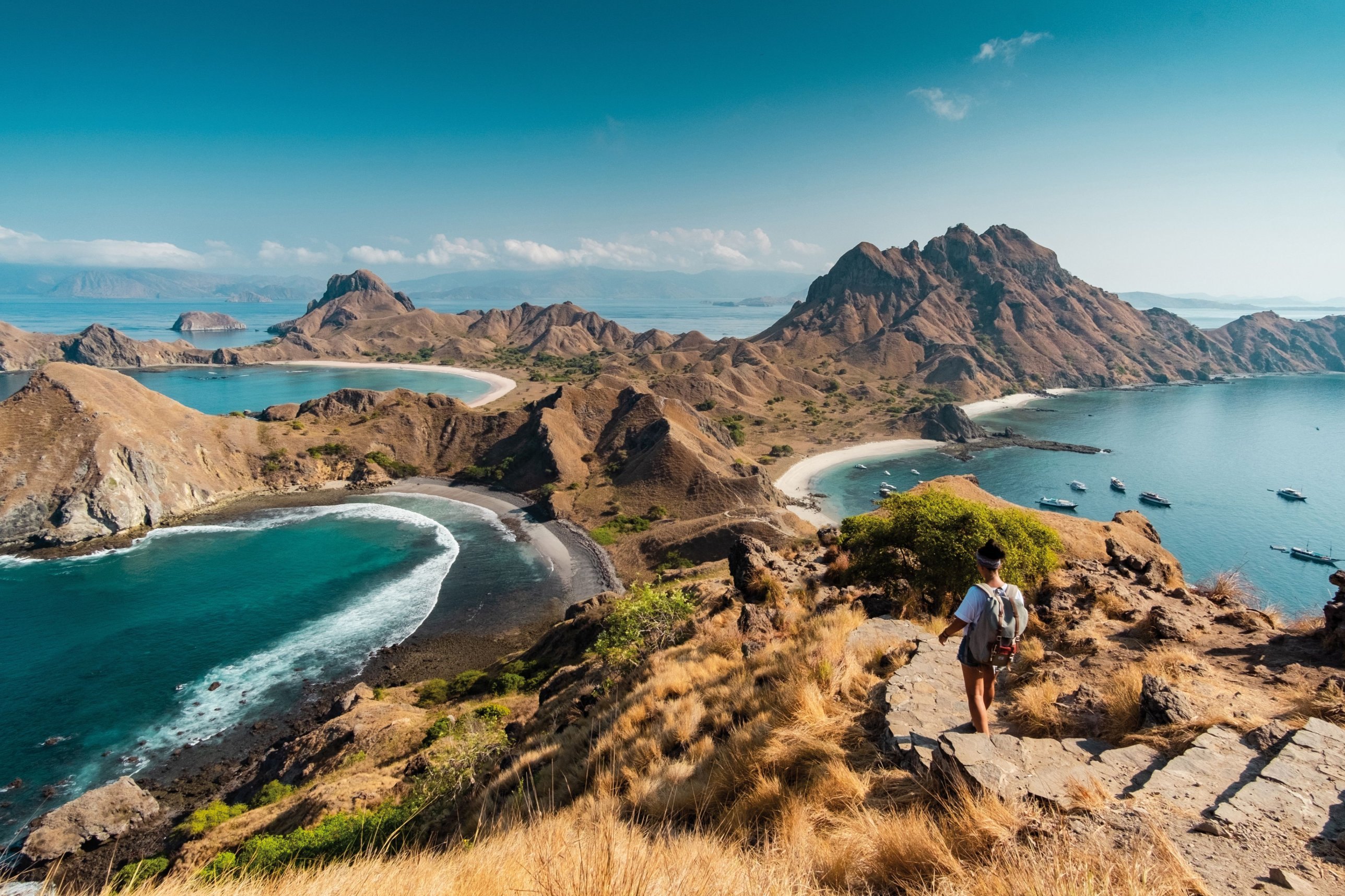
Komodo National Park, between Sumbawa and Flores, is where most liveaboards on this route start, finish or spend the most days. The north offers fast water and big schools of fish, the centre has the reef mantas of Manta Point, and the south is cold and full of invertebrates. Since April 2026 the park has had a daily visitor quota and online registration through the SiOra system, which your operator handles. Our Komodo dive guide covers it in detail.
Alor, at the far eastern end, offers cold, clear water, healthy reefs and currents that need experience, where water squeezes through the Pantar and Ombai straits. Kalabahi is the base for land-based diving, and all flights go via Kupang in West Timor. Bring a thicker suit or a hood: the water can turn noticeably colder within a single dive. Our Alor dive guide maps the main sites.
When is the best time to dive the Lesser Sunda Islands?
For most of the chain, the dry season from roughly April to November brings the best visibility and the calmest seas. The exceptions are Komodo's south, best from about December to March, and Nusa Penida's mola mola season, usually July to October. Bali's north and east coasts can be dived all year.
| Region | Best months | Notes |
|---|---|---|
| Bali (Menjangan, Tulamben, Amed) | All year, best April to November | Calm north and east coasts |
| Nusa Penida | Mantas all year; mola mola July to October | Cold water, strong currents |
| Gili Islands and Sekotong | April to November | Rougher crossings in July and August |
| Moyo and Sangeang | When liveaboards run the Bali to Komodo route | Sangeang depends on the volcano alert level |
| Komodo | North: April to November. South: December to March | Diveable all year |
| Maumere and Alor | Ask local operators | Cold water in Alor; bring a hood |
Land-based or liveaboard?
Land-based diving works best for Bali, the Gili Islands, Komodo (from Labuan Bajo) and Alor (from Kalabahi), each with an airport or a fast boat nearby. Liveaboards reach the places in between, like Moyo and Sangeang, and string several regions together, often between Bali and Komodo or Komodo and Alor. One-way routes run only on set dates, so check schedules early: you fly into one end and out of the other. Airports include Denpasar, Lombok International, Bima, Labuan Bajo, Maumere and Alor via Kupang; beyond Lombok, flights save days. Leave at least 18 hours between your last dive and your flight out.
Quick answers
Is Moyo Island worth diving?
Yes, for divers who want reefs with few other boats. Moyo, off Sumbawa's north coast, is protected and mostly seen from a liveaboard; on land, forest trails lead to waterfalls such as Mata Jitu.
Is Maumere still worth diving?
It depends on what you expect. The 1992 earthquake and tsunami and years of blast fishing badly damaged its reefs, and today it is more a gateway with an airport and liveaboard departures. Ask local operators which reefs have recovered best.
Can beginners dive the Lesser Sunda Islands?
Yes, in the Gilis and on Bali's north coast. Nusa Penida, Komodo's north and Alor need drift-dive experience and a surface marker buoy.
When does the rainy season affect diving?
Roughly November to April, bringing storms and choppier crossings rather than a total stop.
Our Discover Indonesia guides to Lombok, Sumbawa, and Flores and Komodo cover each island in more depth. Browse all our guides, or read our overview of diving in Indonesia.
Facts checked October 2026. Volcano alert levels, park quotas and fees, and flight and ferry schedules change often; check MAGMA Indonesia for Sangeang, Balai Taman Nasional Komodo for park rules, and your operator before you travel.
- Sangeang Api (Smithsonian Global Volcanism Program)
- Taman Wisata Perairan Gili Matra (Wikipedia Indonesia)
- Gili Eco Trust (Gili Eco Trust)
- Gili Islands and Gili Islands travel guide (Wikipedia, Wikivoyage)
- Lombok (Wikipedia)
- Moyo Island (Wikipedia)
- 1992 Flores earthquake and tsunami and Maumere (Wikipedia)
- Alor Island (Wikipedia)
- Komodo National Park limits tourist visits to 1,000 per day (Antara, April 2026)
- Diving in Komodo (Bluewater Dive Travel)
- Komodo park fees 2026 (Neptune Liveaboards)
- Base map licensed; dive sites, airports and harbours added by Discover Indonesia