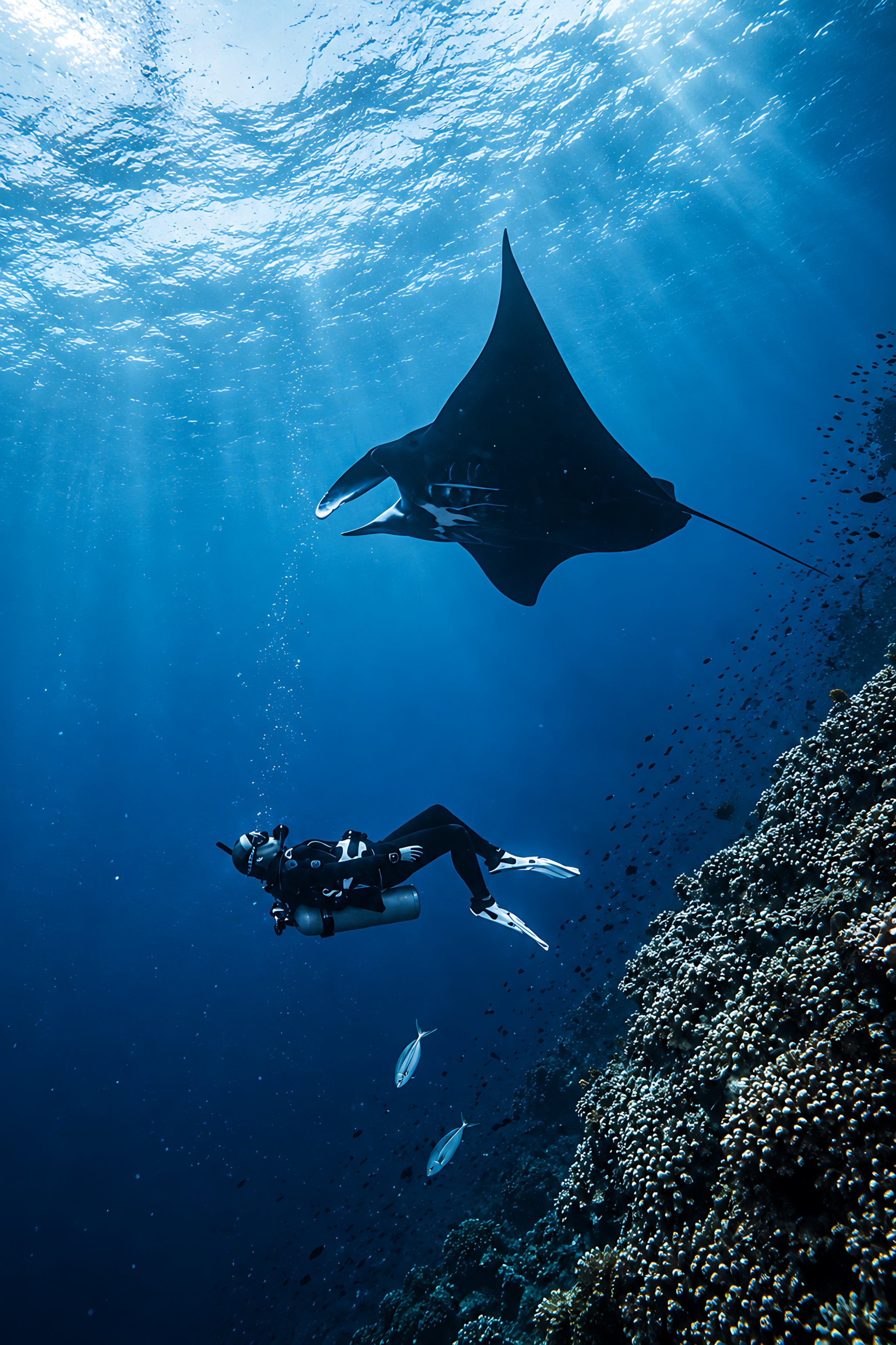
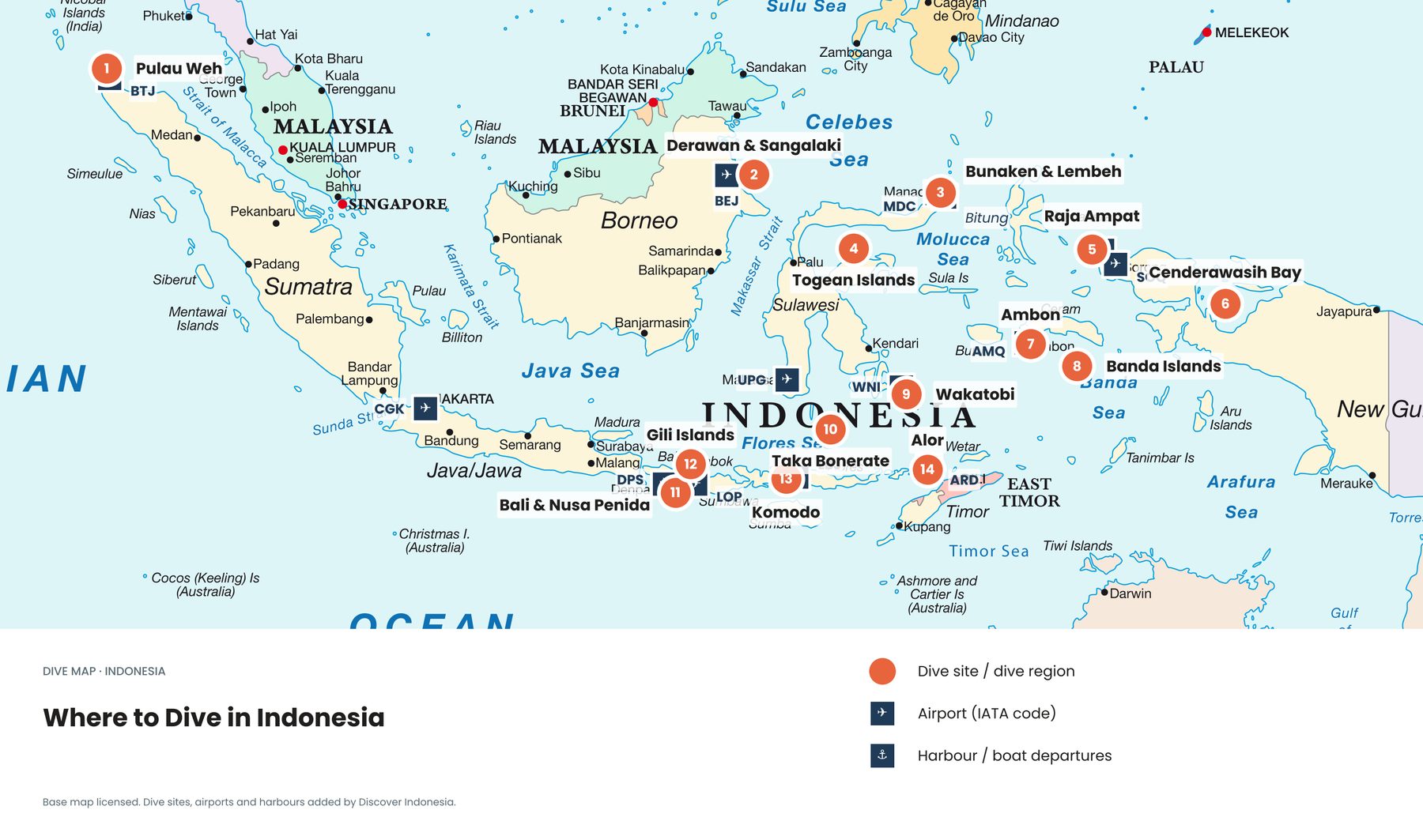
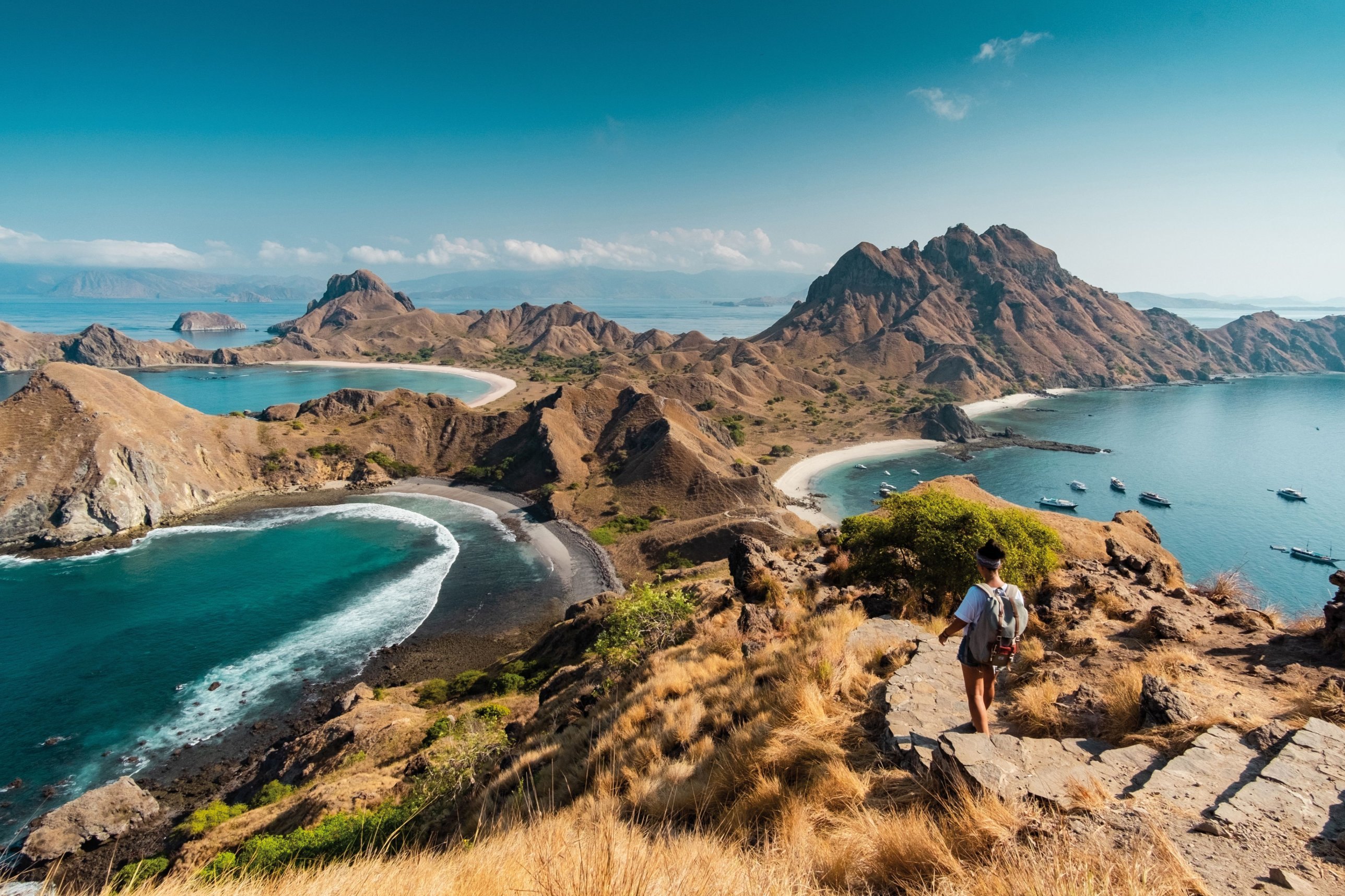
Indonesia's far east is where the Coral Triangle is at its richest and its least visited. Raja Ampat gets the headlines, but the region around it is just as remarkable: whale sharks in Cenderawasih Bay, walking sharks in Triton Bay, volcanoes and nutmeg in Banda, and the strange critters of Ambon Bay.
Where is the best diving in Papua and Maluku?
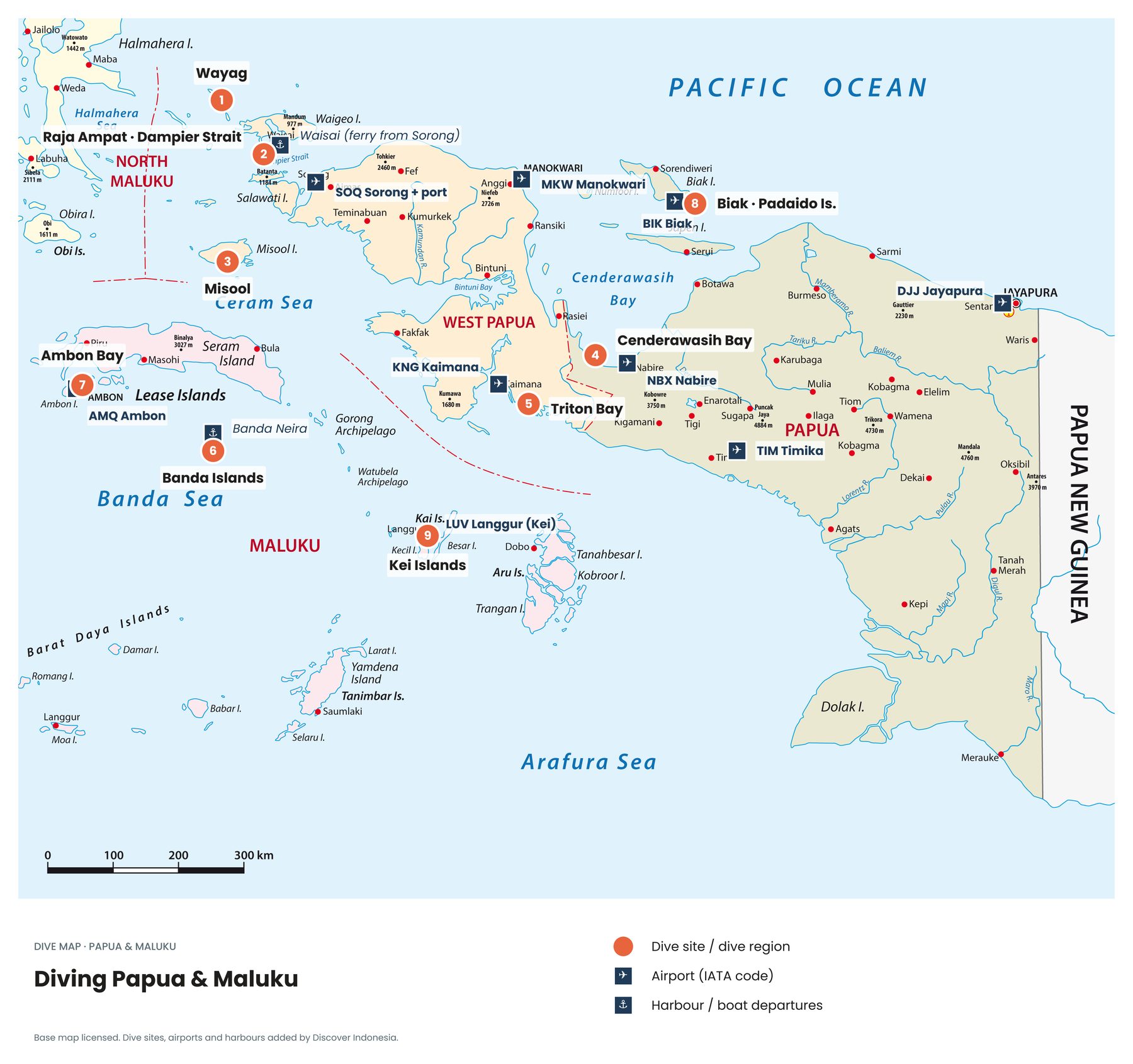
Raja Ampat, off the western tip of Papua, has the richest reefs and the easiest access, with the Dampier Strait, Misool and Wayag as its three main areas. Beyond it, the standouts are Cenderawasih Bay for whale sharks, Triton Bay for soft corals and endemic species, the Banda Islands for walls and history, and Ambon Bay for muck diving. Biak and the Kei Islands are quieter options. The catch is distance: this map spans more than 1,000 kilometres, flights are infrequent and boats get cancelled. Plan one or two regions per trip, with buffer days.
Raja Ampat
- WayagThe karst islands in the far north of Raja Ampat, the view on most postcards. About three and a half to four hours by speedboat from Waisai, so most visitors come on a liveaboard or a long day trip in calm weather.
- Dampier StraitThe heart of Raja Ampat diving: Cape Kri, Sardine Reef, Blue Magic and the reef manta cleaning station at Manta Sandy. Homestays and resorts line the surrounding islands. Ferry from Sorong to Waisai, about two hours. Dampier Strait dive guide →
- MisoolThe southern part of Raja Ampat, known for soft corals, karst lagoons and the community-run Misool Marine Reserve, a no-take area of about 1,220 square kilometres.
Raja Ampat sits at the centre of the Coral Triangle, with more than 1,700 reef fish species recorded. Its reefs are fed by strong tidal currents, and its sharks and mantas are protected by a local sanctuary law. The season runs roughly from October to April; from June to September southerly winds can make crossings rough and many liveaboards pause. Our full Raja Ampat dive guide covers the sites, 2026 entry fees and the nickel mining debate.
Where can you swim with whale sharks in Papua?
- Cenderawasih BayWhale sharks gather around the floating fishing platforms called bagans. The bay is home to Indonesia's largest marine national park. Nabire (NBX) is the nearest airport for the whale shark area.
- Triton BayNear Kaimana on Papua's south coast. Plankton-rich water, very colourful soft corals and a walking shark found almost nowhere else.
- Biak & the Padaido IslandsNorth of Cenderawasih Bay, with reefs, walls and Second World War history around Biak.
In Cenderawasih Bay, on the north coast of Papua, whale sharks feed around the bagans, traditional lift-net fishing platforms, in the south of the bay near Nabire. They come for the small baitfish around the nets, which makes encounters close and unusually reliable. Teluk Cenderawasih National Park covers 14,535 square kilometres, almost 90 per cent of it open sea, and the bay has its own walking shark, the Cenderawasih epaulette shark (Hemiscyllium galei).
Keep a few metres from the shark, never touch it, use no flash, and follow your guide on where to dive: the bagans are the fishermen's livelihood. Fly to Nabire, usually via Biak or another Papuan hub, then continue by boat; the western side is reached from Manokwari. Liveaboards often link the bay with Raja Ampat. Whale shark behaviour depends on the fishing, so ask operators about recent sightings before you commit to dates.
Maluku: the Spice Islands
- Banda IslandsThe tiny islands that were once the world's only source of nutmeg. Walls, big fish, and coral growing over the lava flows of the Gunung Api volcano.
- Ambon BayMuck diving close to the city of Ambon, with critters to rival Lembeh. Ambon's Pattimura Airport (AMQ) has direct flights.
- Kei IslandsSoutheast Maluku, best known for white sand beaches, with quiet reefs around the islands. Langgur (LUV) is the airport.
The Kei Islands, with long white beaches such as Pasir Panjang and very little dive infrastructure, suit travellers who combine a beach stay with some snorkelling or simple diving. Flights connect with Ambon, and the Pelni ship from Banda continues there.
Why dive the Banda Islands?
Banda combines steep walls and clear blue water in the middle of the Banda Sea with some of the richest history in Asia. The small islands were the world's only source of nutmeg and mace until the mid-19th century, and the Dutch East India Company conquered them in 1621. The 640-metre volcano of Gunung Api rises straight out of the harbour at Banda Neira; its eruption on 10 May 1988 sent lava into the sea, and coral has since grown back on the flow off the north shore. Batu Kapal, Pulau Hatta, Pulau Ai and Pulau Pisang are other well-known spots.
Small propeller planes fly from Ambon to Bandaneira (NDA), and a fast boat takes about six hours from Tulehu harbour on Ambon a couple of times a week. The Pelni ship calls roughly twice a month, and Banda Sea liveaboards often combine Banda with Ambon or Raja Ampat. Flights and boats are cancelled often, so leave several spare days before any onward connection.
Is Ambon good for muck diving?
Yes. Ambon Bay, a long inlet that reaches about 20 kilometres into the island, has silty slopes and rubble where frogfish, scorpionfish, nudibranchs and other unusual critters live, close to the city. The psychedelic frogfish (Histiophryne psychedelica) was first photographed there in January 2008, at the site known as Laha, and described as a new species in 2009. It bounces along the seafloor by pushing off with its fins and jetting water through its gill openings, and hides in crevices, so it takes a sharp-eyed local guide to find one.
Muck diving is slow, shallow and detail-focused: little current, long bottom times and a macro lens, a good contrast to the current-swept reefs of Raja Ampat and Banda. Nusa Pombo, a small island between Ambon and Haruku, offers reef diving.
When is the best time to dive Papua and Maluku?
It depends on the region. Raja Ampat is best from October to April. Ambon and central Maluku get most of their rain from May to August, with June the wettest month and November the driest, so the later months of the year are generally better there. Banda Sea crossings are weather-dependent, and liveaboards schedule them for calmer windows. In Cenderawasih Bay and Triton Bay, conditions and whale shark encounters vary with weather and fishing activity, so ask about recent conditions before booking.
Getting around and planning
Fly between hubs, then take a boat. Sorong is the gateway to Raja Ampat, Ambon to Banda and the Kei Islands, Nabire and Manokwari to Cenderawasih Bay, Kaimana to Triton Bay, Biak to the Padaido Islands, and Ternate to Halmahera; most flights connect through Jakarta, Makassar or Manado. Liveaboards are the easiest way to reach Wayag, Misool, Triton Bay, Cenderawasih Bay and the Banda Sea, and many run seasonally. Papua and Maluku are on UTC+9, one hour ahead of Bali.
For a first trip east, dive Raja Ampat's Dampier Strait from land or take a Raja Ampat liveaboard from October to April. Next, try a Banda Sea liveaboard, or Ambon combined with Banda. These are remote areas with slow medical evacuation, so carry dive insurance that covers evacuation, dive conservatively, and don't book tight international connections.
Quick answers
What makes Triton Bay different?
Very colourful soft corals fed by plankton-rich water, which also lowers visibility, and endemics such as Henry's epaulette shark, described in 2008. Fly to Kaimana and continue by boat or liveaboard; dive bases are few, so book ahead.
Can you see hammerheads in Banda?
Schooling hammerheads are reported in the Banda Sea, but sightings are seasonal and unpredictable. Ask about recent encounters rather than planning around a promised month.
Is there good diving around Biak?
Yes, though few foreign divers go. Biak has reefs and walls along its coast and around the Padaido Islands, an airport, and Second World War history; ask local operators which wartime wrecks can be dived.
Can you dive at Halmahera?
Yes, through Ternate or on a liveaboard, though dive infrastructure is thin. It has its own walking shark and the Weda Bay nickel project, so ask operators how coastal development has affected the reefs.
To understand why these reefs are so rich, read our Coral Triangle article and where to see the Coral Triangle. Our Discover Indonesia guides to Raja Ampat, West Papua and Maluku cover the region in more depth; all titles are on the guides page.
Facts checked October 2026. Flights, ferries and liveaboard schedules in eastern Indonesia change often, and whale shark and hammerhead encounters vary from year to year; check with local dive operators, the national park offices and airlines before you travel.
- Teluk Cenderawasih National Park (Wikipedia)
- Taman Nasional Teluk Cenderawasih (Wikipedia Indonesia)
- Cenderawasih Bay (Wikipedia)
- Henry's epaulette shark (Wikipedia)
- Halmahera epaulette shark (Wikipedia)
- Hemiscyllium (walking sharks) (Wikipedia)
- Banda Islands (Wikipedia)
- Banda Api (Wikipedia)
- Banda Islands (Wikivoyage)
- Psychedelic frogfish (Wikipedia)
- Ambon Island (Wikipedia)
- Ambon, Maluku (Wikipedia)
- Biak (Wikipedia)
- Kei Islands (Wikipedia)
- Halmahera (Wikipedia)
- Kaimana Regency (Wikipedia)
- Raja Ampat (Wikivoyage)
- Seasons and temperature (Raja Ampat Marine Park)
- Misool Marine Reserve (Misool Foundation)