At Cape Kri, ichthyologist Gerald Allen once counted 374 fish species in a single 90-minute dive, the highest tally of his career. Most of Raja Ampat's famous dives are packed into one channel: the Dampier Strait, between Waigeo and Batanta. Here is how to dive it, plus Misool, the 2026 fees, the seasons and the mining question.
Why is Raja Ampat diving so special?
Raja Ampat sits at the centre of the Coral Triangle, and its reefs hold more recorded species than almost anywhere else: more than 1,700 reef fish species and over 600 species of hard coral. Fish are abundant as well as diverse, because the reefs are swept by strong, nutrient-rich currents. The name means "Four Kings", after Waigeo, Batanta, Salawati and Misool, surrounded by more than 1,500 small islands, cays and shoals.
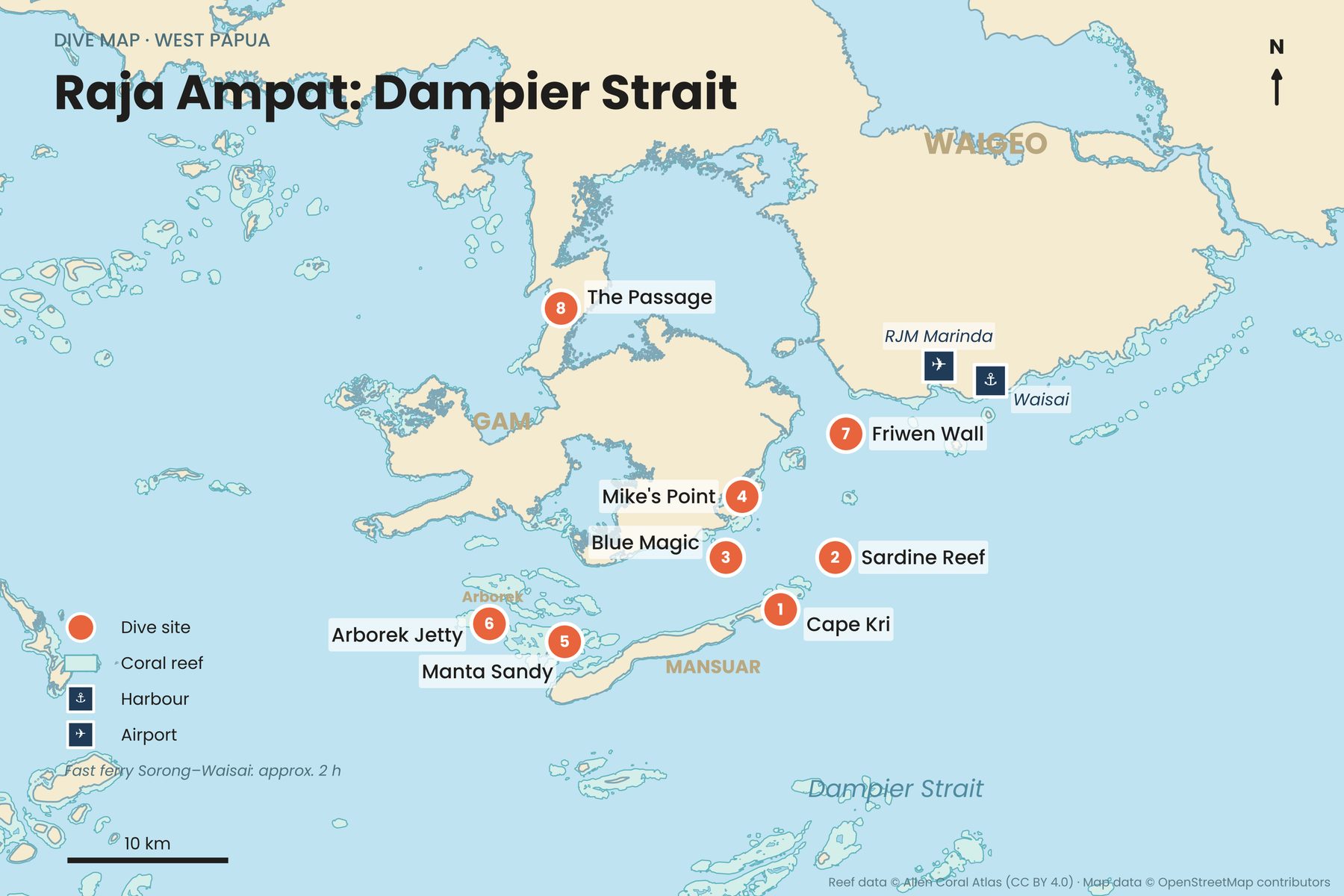
The Dampier Strait runs between Waigeo and Gam to the north and Batanta to the south, and tidal water pours through it. Most homestays and resorts sit on Kri, Mansuar, Arborek and Gam at its edges, which is why these sites can be dived from land. For the bigger picture, see the Indonesian Throughflow.
What are the best dive sites in the Dampier Strait?
The classics are Cape Kri, Sardine Reef and Blue Magic for fish life and current, Manta Sandy for reef mantas, and Arborek Jetty and Friwen Wall for gentler dives. The numbers below match the map.
- Cape KriWhere Gerald Allen counted 374 fish species in 90 minutes. Schools of jacks, barracuda and batfish ride the current along the slope; stay close to the reef.
- Sardine ReefSo thick with fish the coral can be hard to see, with reef sharks on the edges. Often a strong drift.
- Blue MagicA submerged pinnacle in mid-strait, with oceanic mantas in season, reef sharks and tuna. Negative entries; experienced divers only when the current runs.
- Mike's PointA small island with walls of soft corals and sea fans. Your guide picks the sheltered side.
- Manta SandyA shallow, usually calm cleaning station near Arborek where divers wait behind a line of rocks. Crowded in high season.
- Arborek JettyFish schools around the pylons and good critters below. Superb snorkelling and a strong night dive.
- Friwen WallA gentle soft-coral wall near Waisai, a common first dive.
- The PassageA narrow channel between Gam and Waigeo that feels like a saltwater river, usually timed for slack water.
Where can you see manta rays in Raja Ampat?
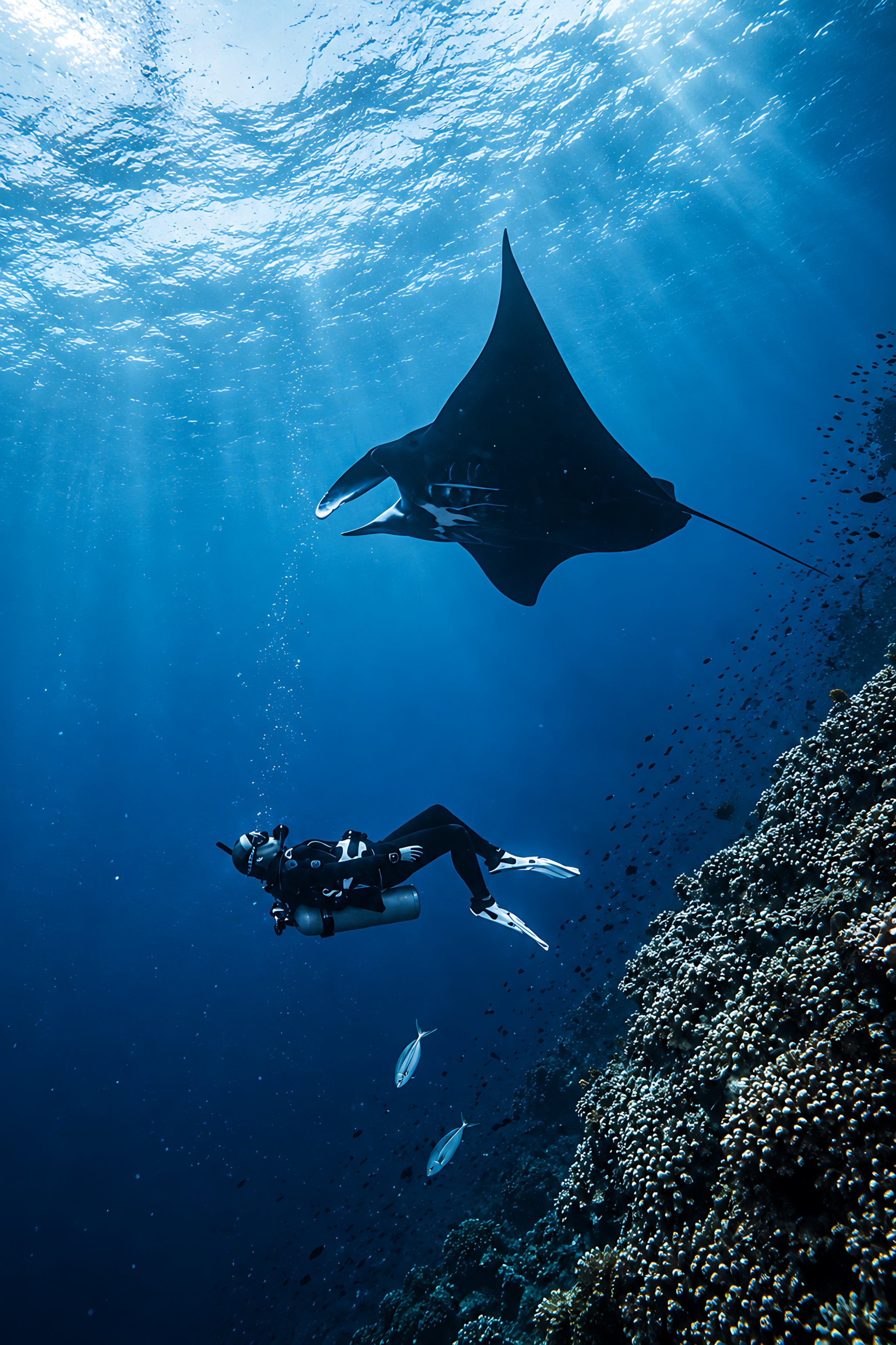
Reef mantas visit the cleaning station at Manta Sandy near Arborek, while oceanic mantas pass Blue Magic and other open-water pinnacles; mantas also gather around Misool. The best months are roughly October to April, and sightings are much less reliable in September. A University of Auckland-led study published in 2022 found the resident reef manta population of the Dampier Strait grew from 226 to 317 rays between 2009 and 2019, an annual increase of about 3.9 per cent, credited to strong marine protected areas and the ban on fishing mantas.
At Manta Sandy, stay behind the rock line and keep low. Never touch or chase a manta or block its path, and snorkellers should enter the water quietly, away from the rays.
Misool and Wayag: is the trip worth it?
Misool is, if you have four or five days. The southernmost of the four kings is quieter than the Dampier Strait and known for soft corals, limestone islands and marine lakes with harmless jellyfish. It is reached by liveaboard, resort transfer or slow overnight public boat from Sorong. The Misool Marine Reserve, created in 2005 with local communities, covers about 1,220 square kilometres; its managers report that fish biomass rose by an average of 248 per cent between 2007 and 2021.
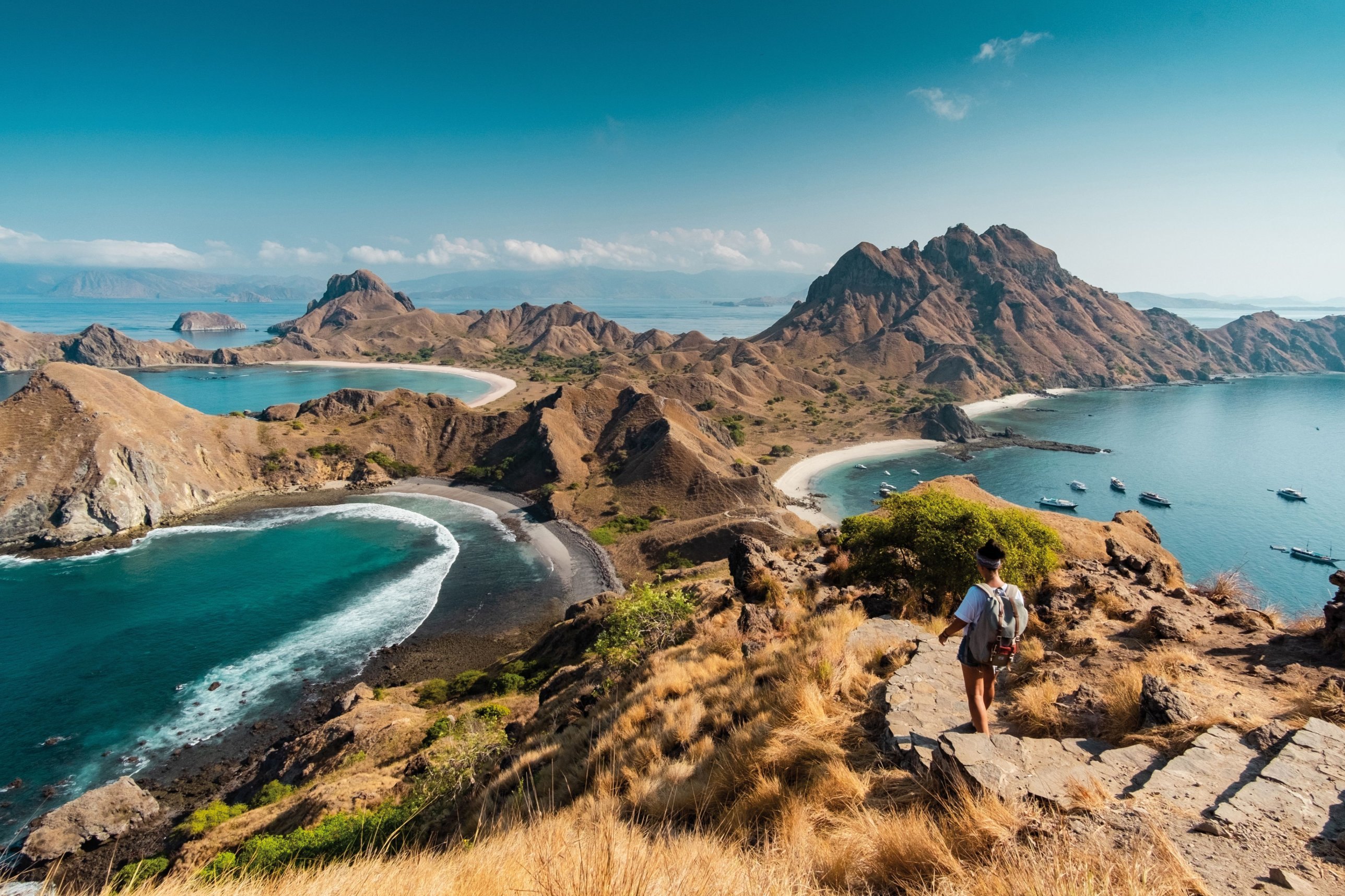
Wayag, the karst islands on most Raja Ampat photographs, is more for the view than the diving. It lies about three and a half to four hours by speedboat from Waisai, so many travellers see it on a liveaboard. Piaynemo offers a similar lookout about 1.5 to 2 hours from Waisai.
Getting there and where to stay
Fly to Sorong (SOQ), which has direct flights from Jakarta, Makassar and Manado, then take the Express Bahari fast ferry to Waisai on Waigeo, about two hours in calm seas. It runs daily at 14:00, with an extra 09:00 sailing on some days in the busier months; schedules change at short notice, so confirm locally. Papua is one hour ahead of Bali, and a midday arrival is risky for the ferry, so many divers stay a night in Sorong.
Family-run homestays on Arborek, Kri, Mansuar, Gam and Saonek are the cheapest and put money straight into local hands. Resorts on Kri, Mansuar and Gam add their own boats and dive centres. Liveaboards, mostly from about October to April, are the only practical way to cover Wayag to Misool in one trip, though some barely leave the Dampier Strait.
How much is the Raja Ampat entry fee in 2026?
As of late 2026, foreign visitors pay two separate charges that together come to around IDR 2,000,000 per person. The marine park tag is around IDR 1,000,000 and is valid for a year; the regency's visitor levy is around IDR 1,000,000 per visit. Children under 12 are exempt from both, though they still need to be registered.
Both rose in 2026: the levy from IDR 300,000 in January, and the marine park tag reportedly from IDR 700,000 in August, applied immediately even to trips sold months earlier. Register online through the regency's SIPARI system before you go. The tag can be bought online, at Sorong harbour or in Waisai, largely in cash, and many resorts and liveaboards add it to your bill.
When to go, and how strong are the currents?
October to April is the best season, with calmer winds, smoother crossings and the peak of manta activity. From June to October, and especially in July and August, southerly winds can make the seas rough and many liveaboards stop running, though land-based diving continues with fewer boats. The water is around 28 to 30°C in the main season, and a 3 mm wetsuit is enough for most divers.
Cape Kri, Sardine Reef, Blue Magic and Mike's Point can run hard on a big tide, strongest around full and new moon. Carry a surface marker buoy and a whistle, expect negative entries at pinnacles, and if a down-current pulls you, move away from the reef edge and ascend along the slope, not in the blue. Evacuation from here is slow and expensive, so buy dive insurance that covers it, and leave at least 18 hours before flying out of Sorong after several days of diving.
How is Raja Ampat protected, and what about nickel mining?
Raja Ampat has a network of 26 marine protected areas covering about 5.2 million hectares, a shark and ray sanctuary made law in 2013, and national protection for both manta species since 2014. It became a UNESCO Global Geopark in 2023 and a biosphere reserve in 2025. Your fees fund patrols, and homestay income gives villages a reason to protect reefs. Keep fins off the reef, don't feed fish, and take your rubbish back to the mainland.
In June 2025 the government revoked the permits of four of the five nickel miners in Raja Ampat after Greenpeace Indonesia published videos of cleared forest. The fifth, PT Gag Nikel on Gag island, resumed on 3 September 2025 and, as of August 2026, is the only mine the government says is still operating there. A Greenpeace report in July 2026 said three new licences were being processed for eastern Waigeo. None of the dive sites on this map lie on the mining islands, but sediment travels with currents, so ask your operator for the latest.
Quick answers
Is Raja Ampat good for beginners?
Yes, at sites like Friwen Wall, Arborek Jetty and Manta Sandy, but you will get more out of it if you are comfortable with drift diving.
How long should I spend in Raja Ampat?
At least a week in the Dampier Strait after the travel days, plus four to five days for Misool or a liveaboard, and a spare day before your flight home.
Do I need cash in Raja Ampat?
Yes. Bring enough from Sorong for fees, tips and homestays; card payments are unreliable on the islands.
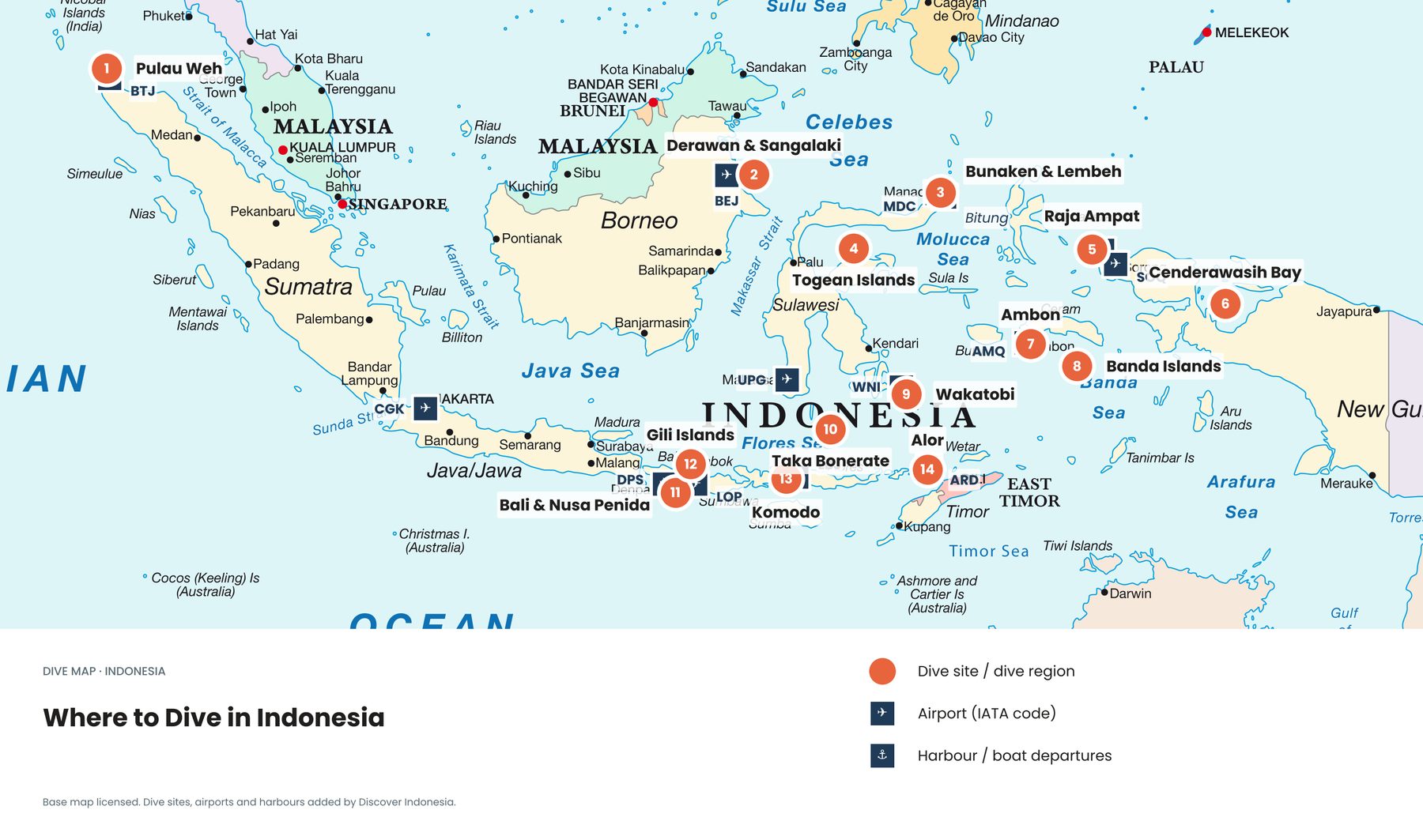
For Cenderawasih Bay, Triton Bay and Banda, see our Papua and Maluku dive guide, and the science behind the reefs is in our Coral Triangle article. Our Discover Indonesia guides to Raja Ampat and West Papua cover the region in more depth; find them all on the guides page.
Facts checked October 2026. Entry fees, ferry schedules and the mining situation have all changed in the past year; confirm fees with the Raja Ampat marine park authority (KKP Raja Ampat) and the regency's SIPARI system, and check ferry times locally in Sorong.
- One Fish, Two Fish, 374 Fish (Scuba Diving)
- A Magnum Opus of Tropical Reefs (DAN Alert Diver)
- Raja Ampat Islands, with cited species surveys (Wikipedia)
- Strong marine protected areas credited with manta ray surge in Indonesia (Mongabay)
- Conservation Success in Indonesia (DAN Alert Diver)
- Misool Marine Reserve (Misool Foundation)
- Raja Ampat designated a UNESCO Biosphere Reserve (Bird's Head Seascape)
- Seasons and temperature (Raja Ampat Marine Park)
- Raja Ampat Dive Season Explained (Bluewater Dive Travel)
- Raja Ampat raises tourism fees to support conservation and communities (TTG Asia)
- Update on official fees in Raja Ampat (Raja Ampat Biodiversity)
- Raja Ampat entry fees and registration 2026 (Ocean Earth Travels)
- Sorong to Waisai ferry schedule 2026 (Ocean Earth Travels)
- Raja Ampat (Wikivoyage)
- Indonesia revokes nickel mining permits in Raja Ampat (Fortune / AP)
- Nickel mining in Indonesia's Raja Ampat continues despite protests, Greenpeace finds (Reuters via Mining Weekly)
- Bahlil: no new mining permits in Raja Ampat, only Gag Nikel (Bisnis.com)
- Allen Coral Atlas (reef data for the map, CC BY 4.0)