South of Sulawesi, in the middle of the Flores Sea, a field of reefs, lagoons and sandy islands spreads across some 2,200 square kilometres. This is Taka Bonerate, Indonesia's largest atoll and one of the largest in the world, and one of the country's least visited national parks.
What is Taka Bonerate?
Taka Bonerate is a huge coral atoll in the Flores Sea, south of mainland Sulawesi, protected as a marine national park since 1992. The park covers about 530,765 hectares, of which roughly 220,000 hectares are the atoll itself: reef flats, lagoons, sandbanks and 21 small islands. It belongs to the Selayar Islands regency of South Sulawesi.
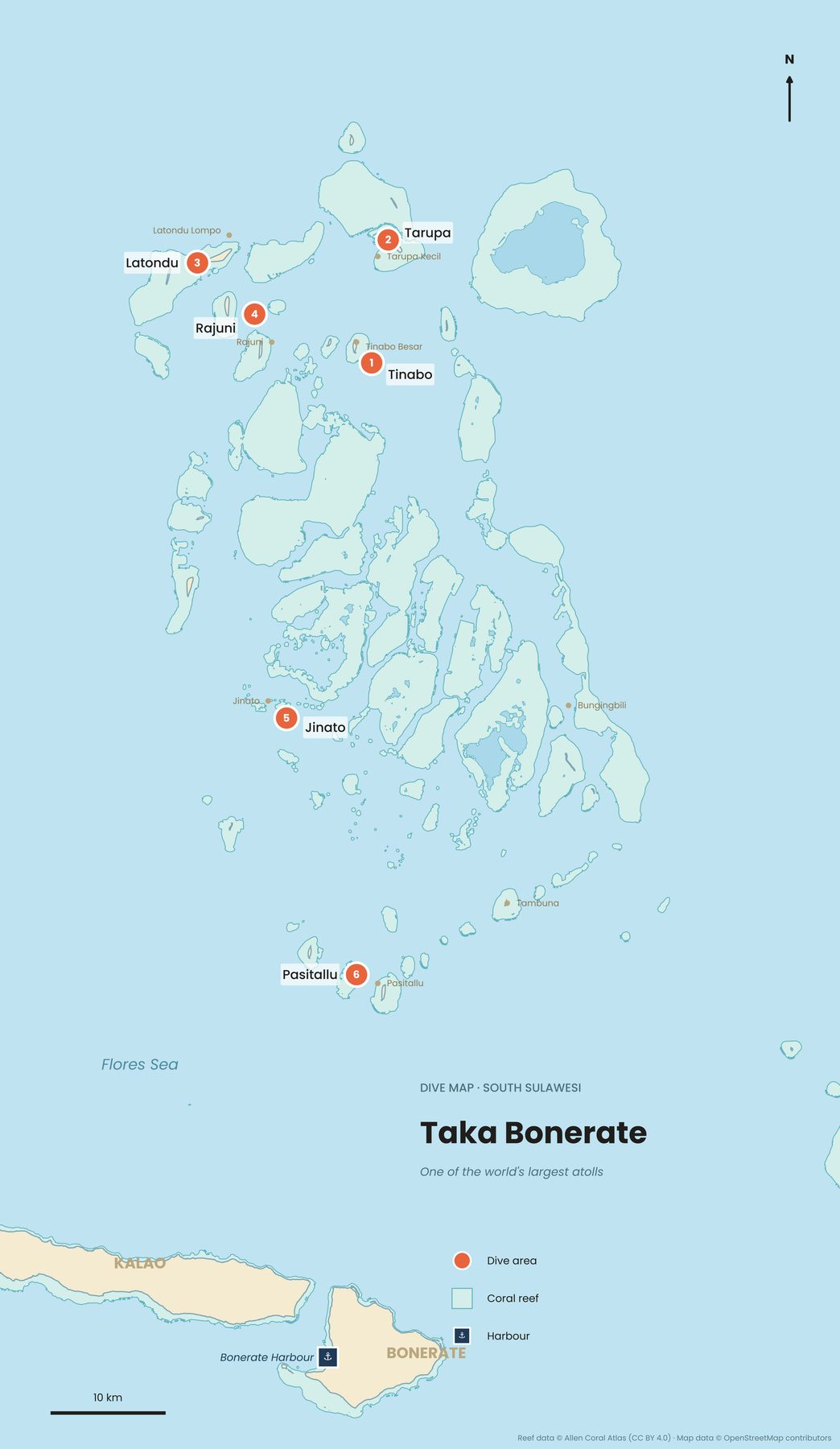
The ring of reefs is broken into dozens of separate reefs and patch reefs, so on the map it looks less like a neat circle and more like a scattered field of shallows, with outer edges that drop steeply into the Flores Sea. The name comes from Bugis and roughly means coral piled up on sand. Indonesia submitted it to UNESCO's World Heritage tentative list in 2005, and in 2015 its core zone became part of the Taka Bonerate-Kepulauan Selayar biosphere reserve.
What is the diving like?
Taka Bonerate is known for walls on the atoll's outer edges, sloping reefs around the islands and shallow sandy flats inside the lagoon. Visibility is often around 30 metres on the outer reefs. The park and government sources give between about 240 and 260 coral species and several hundred reef fish species.
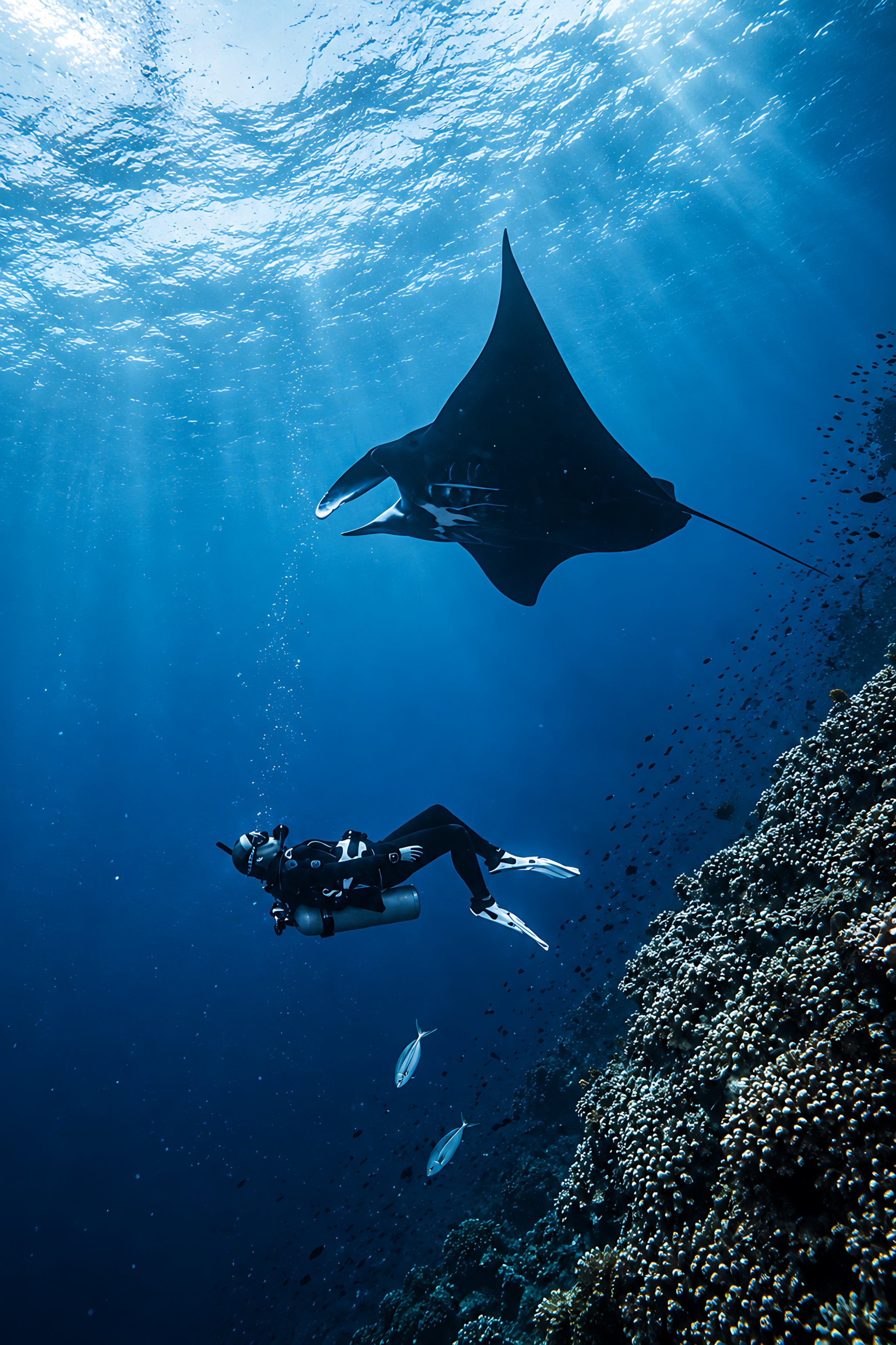
Hawksbill, green and olive ridley turtles live here, and turtles nest on some of the islands. The park's tourism material also lists manta rays, dolphins, reef sharks and occasional sperm whales, along with large gorgonian sea fans, black coral and Napoleon wrasse. Government sources mention more than 50 dive sites, many of them close to Tinabo, and because so few divers come, there is still real exploration to be done.
The dive areas
These six areas, numbered as on the map, cover the islands that visitors and liveaboards use most. Several are inhabited villages, so expect fishing boats and village life on the beaches between dives.
- TinaboThe island most visitors start from, in the north of the atoll, with the park's field base. Shallow sandy flats and reef edges lie right off the beach, and young reef sharks are often seen in the shallows.
- TarupaAn inhabited island in the north, with reef slopes dropping into deeper water and a shallow reef flat off Tarupa Kecil that suits snorkellers.
- LatonduA northwestern island with reefs on the atoll's outer edge, where the drop-off is close to the islands.
- RajuniRajuni Besar and Rajuni Kecil are inhabited islands in the north. Local boats from Selayar sometimes run to Rajuni Kecil, a possible stepping stone into the park.
- JinatoAn inhabited island on the western side of the atoll and a stop on the public ferry route from Bira, one of the few places in the park reachable without a charter.
- PasitalluPasitallu Tengah and Pasitallu Timur lie in the south, the closest dive area to Bonerate Island and a long way from the usual base on Tinabo.
Who lives on the atoll?
Seven of the islands are inhabited: Tarupa, Rajuni Kecil, Rajuni Besar, Latondu Besar, Jinato, Pasitallu Tengah and Pasitallu Timur. Their people are mostly Bugis, Indonesia's great boat-building and seafaring people, and Bajau, who traditionally live on and from the sea. The islands are low sand cays with no rivers, and residents rely on rainwater and water shipped in from Selayar. If you stay on an island, use water sparingly, and expect simple food based on fish and rice.
How healthy are the reefs?
Many reefs in Taka Bonerate are in good condition, helped by sheer distance and low visitor numbers. But divers have reported dynamite damage in parts of the park, and around Bira and Selayar blast fishing has been documented for years; operators normally dive the undamaged areas. A 2022 study in Biodiversitas found reefs around Tambolongan and Polassi, two islands near Selayar outside the atoll, in very poor health under heavy human pressure. Like reefs across the region, Taka Bonerate is also exposed to marine heatwaves; see also marine protected areas in the Coral Triangle.
Visitors can help. Pay the national park entry fee and ask for a receipt, as it funds the rangers on Tinabo. Do not buy turtle shell, giant clam or coral souvenirs, choose operators that use moorings or drift diving rather than anchoring on the reef, and take your rubbish back to Selayar.
How do you get to Taka Bonerate?
All routes run through Makassar and Selayar. Flights have run from Makassar to Aroeppala airport on Selayar, with Wings Air the main operator over the years, but schedules change often. By land, it is about 200 kilometres and roughly five hours from Makassar to Bira, then about two hours by ferry to Pamatata on Selayar and around an hour by road to Benteng. A morning air-conditioned bus from Makassar rides the ferry across, the simplest option without a car.
There is no regular passenger service from Benteng to Tinabo. Most visitors charter a speedboat, often as a package of several days with a basic room on Tinabo; the ride takes roughly four to eight hours. The state ferry KMP Taka Bonerate sails a loop from Bira calling at Jinato and Bonerate several times a month, so check the current schedule with ASDP's Selayar office. A few liveaboards include the atoll in the Flores Sea; they carry their own water, compressors and safety equipment and reach outer walls that day boats rarely visit.
When is the best time to dive Taka Bonerate?
The best windows are April to mid-May and October to mid-November, when winds are light and the sea is calm. During the west monsoon, roughly December to March, waves can reach two metres or more and ferries may be cancelled.
| Months | Conditions | Verdict |
|---|---|---|
| December to March | West monsoon, rough seas, ferries can stop | Avoid |
| April to mid-May | Calm seas, good visibility | Best |
| June to September | Stronger winds on some days, cooler water | Possible, check forecasts |
| October to mid-November | Calm seas, good visibility | Best |
Plan your trip
Bring your own dive gear and spares, as rental equipment on the islands is limited. Dive conservatively and carry a surface marker buoy: the atoll is many hours from a hospital and further still from a recompression chamber. Carry enough cash for boats, food and fees, since Benteng is the last reliable place for it, pack water and food basics, and leave buffer days, because boats wait for the weather.
Quick answers
Is Taka Bonerate the third-largest atoll in the world?
That is how Indonesia describes it, after Kwajalein and Huvadhu, though rankings that include submerged reef banks put other structures ahead. It is safely the largest atoll in Indonesia and Southeast Asia, at about 2,200 square kilometres.
Can you stay on Taka Bonerate?
Yes, but facilities are basic. Tinabo has simple rooms, often booked with a boat charter from Selayar, and some inhabited islands have homestays. There are no large resorts.
Is Taka Bonerate good for snorkelling?
Yes. The reef flats around Tinabo and Tarupa are shallow, and young reef sharks are often seen near the beaches.
How many days do I need?
At least five or six days from Makassar for three days on the atoll, more if you travel by ferry.
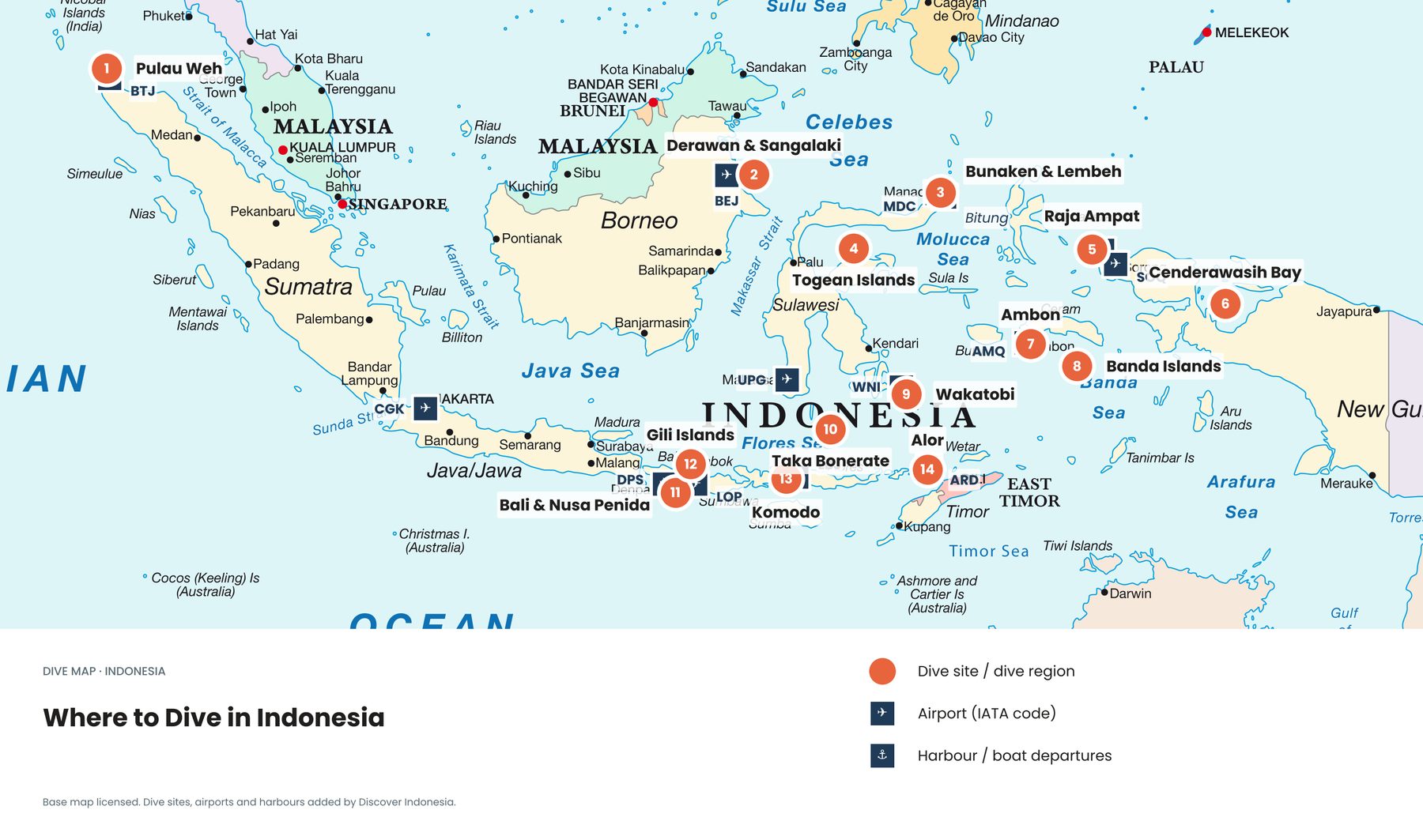
Wakatobi lies across the Flores Sea to the east; our Sulawesi diving overview and map of Indonesia's dive regions show how it fits together. Our upcoming Discover Indonesia guide to Taka Bonerate covers it in more depth; see the guides page.
Facts checked October 2026. Flights to Selayar, ferry schedules and park fees change often; confirm them with the airlines, ASDP Selayar and Taka Bonerate National Park (Balai Taman Nasional Taka Bonerate) before you travel.
- Taka Bonerate National Park, tentative list (UNESCO World Heritage Centre)
- Taka Bonerate National Park (Wonderful Indonesia)
- Taka Bonerate National Park (Wikipedia)
- Taka Bonerate, Indonesia's coral reef paradise (The Jakarta Post)
- RI biosphere reserves recognized by UNESCO (The Jakarta Post)
- Beginilah surga di Takabonerate (Mongabay Indonesia)
- Jadwal feri rute Bira lintas Pulau Selayar (detikSulsel)
- The health status of coral reef ecosystem in Taka Bonerate, Kepulauan Selayar Biosphere Reserve (Biodiversitas)
- The largest atolls in the world (WorldAtlas)
- Diving South Sulawesi (Starfish.ch)
- Reef data: Allen Coral Atlas, CC BY 4.0
- Map data © OpenStreetMap contributors, ODbL