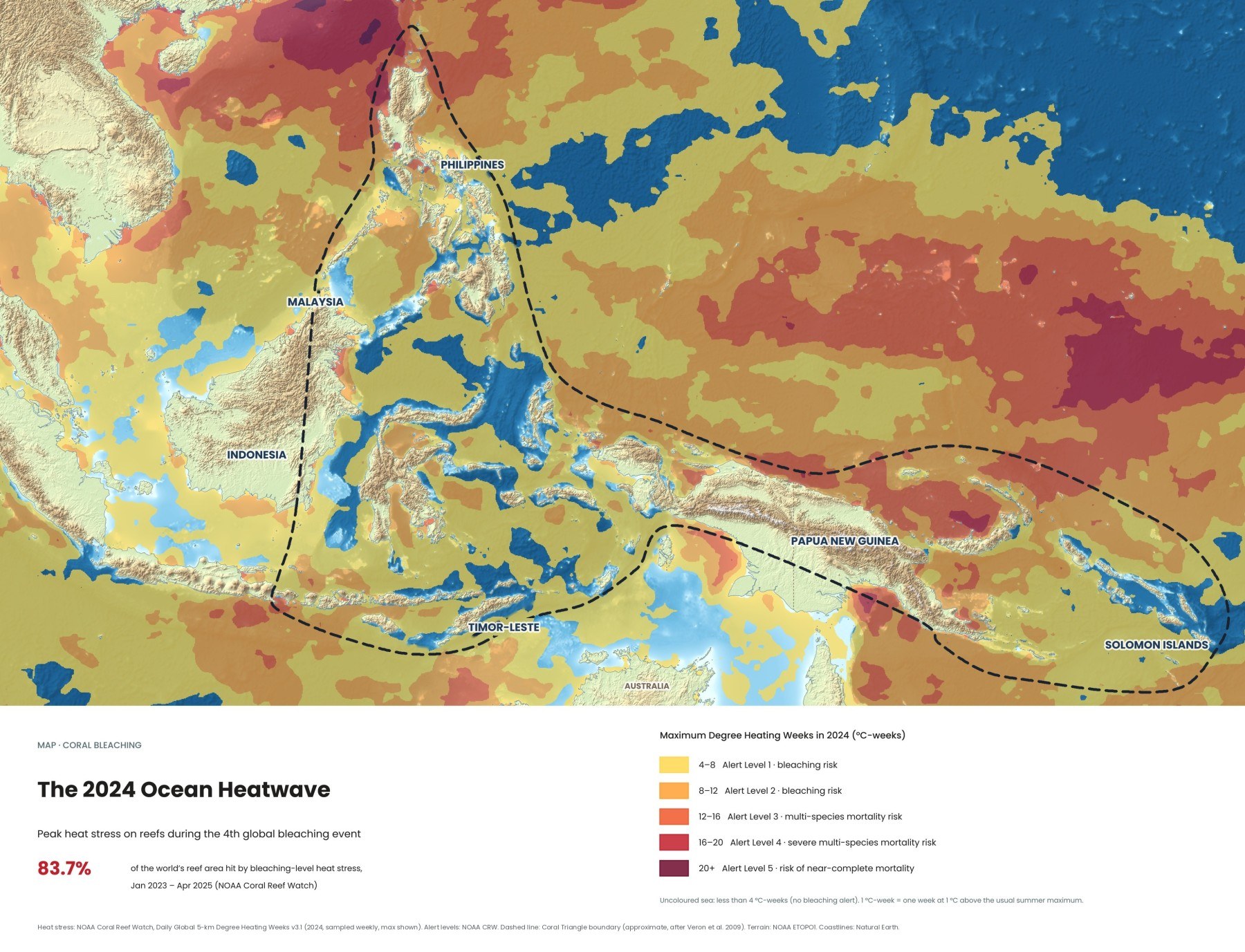
From early 2023 to mid-2025, bleaching-level heat stress reached about 84% of the world's coral reef area, according to NOAA Coral Reef Watch. It was the fourth and largest global bleaching event on record. This map shows how 2024 played out across the Coral Triangle, and the article explains what it meant for Indonesia's reefs and what comes next.
What is coral bleaching?
Coral bleaching is what happens when water stays too warm for too long and corals expel the microscopic algae living in their tissue. Those algae make food from sunlight and give corals most of their colour, so without them the coral turns white. A bleached coral is starving, but it is not yet dead. If the water cools in time, the algae can move back in; if the heat lasts, corals starve, become prone to disease and die.
Not every coral reacts the same way. In Raja Ampat in 2024, small branching Stylophora colonies turned white first, and in Jakarta's Thousand Islands bleached colonies often sat right beside healthy ones. That is why one dive site can tell a very different story from the next.
What was the fourth global bleaching event?
A run of marine heatwaves from early 2023 that pushed reefs in the Pacific, Atlantic and Indian Oceans past their limits at once. NOAA confirmed it on 15 April 2024, and in June 2026 announced that it had likely ended in mid-2025, with the severe bleaching in Western Australia in early 2025 as its last major chapter. By then bleaching-level heat stress had reached about 84% of the world's reef area. The map above was drawn during the event and shows the figure as it stood in April 2025, 83.7%.
| Global event | Reef area under bleaching-level heat stress |
|---|---|
| 1st: 1998 | 21% |
| 2nd: 2010 | 37% |
| 3rd: 2014 to 2017 | 68% |
| 4th: 2023 to 2025 | 84% |
Every strong El Niño since 1998 has coincided with a global event. The difference now is the baseline: a 2026 study in Coral Reefs by NOAA Coral Reef Watch scientists and colleagues found that average global sea surface temperature in 2019 to 2023, years without a strong El Niño, already matched the peak of the strong 1997 to 1998 El Niño. Reefs, they concluded, have entered an era of near-annual bleaching risk.
What are Degree Heating Weeks?
Degree Heating Weeks (DHW) measure how much heat a reef has absorbed over the past 12 weeks, counting only water at least 1°C above that location's normal summer maximum. One DHW is roughly one week at 1°C above that maximum, or half a week at 2°C above it. NOAA Coral Reef Watch calculates it daily from satellite data on a 5-kilometre grid.
| Level | Condition | Likely impact |
|---|---|---|
| Bleaching Watch | Water above the summer maximum, but by less than 1°C | None yet |
| Bleaching Warning | HotSpot 1°C or more, DHW below 4 | Possible bleaching |
| Alert Level 1 | 4 to 8 DHW | Reef-wide bleaching |
| Alert Level 2 | 8 to 12 DHW | Reef-wide bleaching, heat-sensitive corals die |
| Alert Level 3 | 12 to 16 DHW | Mortality across many species |
| Alert Level 4 | 16 to 20 DHW | Severe mortality, more than half of corals |
| Alert Level 5 | 20 DHW and above | Near-complete mortality, more than 80% of corals |
The 4 DHW threshold is a broad-scale signal, not a promise. Local reefs can bleach below it or hold on above it depending on their corals, currents and history.
How do you read the 2024 map?
The map shows the highest DHW value each part of the sea reached at any point in 2024. Uncoloured sea stayed below 4 DHW; yellow is Alert Level 1, deepening through orange and red to the dark purple of Alert Level 5. The most extreme heat sat outside Indonesia, in the Pacific north and east of Papua New Guinea and in the northern South China Sea. South of Java and in the Arafura Sea, orange and red patches mark Alert Levels 2 to 4.
Inside Indonesia, much of the shallow Java Sea and the waters around Borneo show Alert Level 1, while large parts of the deep Makassar Strait, Molucca, Banda and Flores seas stayed below the threshold. There the Indonesian Throughflow and strong tides mix cooler water up from depth, which may have helped some reefs, although it is no guarantee. More on the Indonesian Throughflow → The map covers only 2024, so it misses late 2023, when Bali bleached, and it shows heat, not damage.
What happened to Indonesia's coral reefs?
Indonesia was hit unevenly: some reefs bleached severely, others close by showed little or no damage. The country holds about 5.1 million hectares of coral reef, around 18% of the world total, by its tourism ministry's figures.
Bali, late 2023. On the north coast near Bondalem, conservationist Nyoman Sugiarto told Reuters that about 90% of the corals he had been nurturing since 2008 lost their colour in December 2023. Marthen Welly of the Coral Triangle Center warned that bleaching could return every one or two years at current temperatures.
Thousand Islands, 2023 to 2024. The most detailed published Indonesian record, in Diversity in 2025, found patchy bleaching of at most about 10 to 15% of corals after a heatwave reached 4.8 DHW, then a second peak of 8.1 DHW in June 2024, the highest there since 2010. Of 42 tagged bleached colonies, 36% had fully recovered by May 2024, 26% had partly recovered and 38% had died.
Raja Ampat, December 2024. After coming through the 2016 to 2017 and 2021 heatwaves largely unharmed, the Dampier Strait bleached widely, with water around 31°C. The Sea People, a monitoring group on Mansuar, called it the largest event they had recorded. Misool, the Gam Hole and Wayag showed no visible bleaching even at 30 to 31°C; more areas were unaffected or lightly affected than affected. Our Raja Ampat dive site map → For most other regions, from Komodo to Wakatobi, the 2024 effect is not yet documented.
What is the coral bleaching situation in 2026?
As of October 2026, the fourth global event is officially over, but the next risk is already building. NOAA's Climate Prediction Center issued an El Niño Advisory, and on 8 October 2026 it rated a strong to very strong El Niño as likely through January to March 2027, with a real chance of the strongest event since 1950. "We are now in the era where reefs will bleach on a near-annual basis," said Derek Manzello, coordinator of NOAA Coral Reef Watch.
What this means for Indonesia nobody can say with certainty yet; in the episodes above, heat stress came between December and June. The practical step is to watch NOAA Coral Reef Watch's four-month bleaching outlook, updated weekly with a Coral Triangle map, and its daily Bleaching Alert Area maps.
What can divers do to help reefs during bleaching?
Above all, avoid adding stress to corals that are already struggling, and report what you see. A bleached reef is still alive, so keep diving it, carefully.
- Perfect your buoyancy. A fin kick or a hand on the reef does more harm to a heat-stressed coral than to a healthy one.
- Skip the sunscreen in the water. Wear a rash guard or thin wetsuit instead.
- Report bleaching, and healthy reefs too. In Raja Ampat, The Sea People and the marine park authority run a two-minute online survey after each dive. Healthy sites show where the refuges are.
- Pay park fees and choose careful operators that use moorings and keep groups small.
- Think about crowding. When the Dampier Strait bleached, 28 liveaboards moved to Misool within days, shifting the pressure rather than removing it.
Quick answers
Can bleached coral recover?
Yes, if the heat ends soon enough; corals that regain their algae within weeks to months usually survive. Dead corals are replaced only slowly, over years, and repeated bleaching gives reefs less time to recover.
Is the fourth global bleaching event over?
Yes. In June 2026 NOAA announced that it had likely ended in mid-2025, but warned that the emerging El Niño could bring widespread bleaching back.
How do I check heat stress before a dive trip?
Look up your destination's current alert level and the four-month outlook on NOAA Coral Reef Watch, which is free. If an alert is active, ask your operator what they are seeing.
When did Indonesia first record coral bleaching?
In 1983, at Pari Island in the Thousand Islands north of Jakarta.
Healthy reefs have stayed within reach of damaged ones in every recent event: see our ten best places to see the Coral Triangle, the full set of eight Coral Triangle maps and our article on marine protected areas. Our Discover Indonesia diving and Coral Triangle guides go deeper; browse them all on our guides page.
Facts checked October 2026. Heat stress, alert levels and El Niño forecasts change week by week; check NOAA Coral Reef Watch and NOAA's Climate Prediction Center before you travel, and ask your dive operator or the local marine park about current reef conditions.
- World's fourth mass coral bleaching event likely ended in 2025 (NOAA NESDIS, June 2026)
- The most intense global coral bleaching event on record has likely ended, NOAA confirms (Global Coral Reef Monitoring Network, June 2026)
- Methodology: 5km Degree Heating Week and Bleaching Alert Area (NOAA Coral Reef Watch)
- Four-Month Coral Bleaching Outlook (NOAA Coral Reef Watch)
- The 4th global coral bleaching event: ushering in an era of near-annual bleaching (Reef Resilience Network, summary of Spady et al., Coral Reefs, 2026)
- ENSO Diagnostic Discussion (NOAA Climate Prediction Center, 8 October 2026)
- Coral Bleaching and Recovery on Urban Reefs off Jakarta, Indonesia, During the 2023–2024 Thermal Stress Event (Razak et al., Diversity, 2025)
- Coral bleachings devastate Bali reefs as sea temperatures rise (The Jakarta Post / Reuters, July 2024)
- Warming waters trigger coral bleaching in areas of Raja Ampat (Bird's Head Seascape, December 2024)
- Reef health / coral bleaching monitoring survey from The Sea People (Bird's Head Seascape, January 2025)
- Map: NOAA Coral Reef Watch Daily Global 5-km Degree Heating Weeks v3.1. Boundary: approximate, generalised by Discover Indonesia after Veron et al. (2009). Terrain: NOAA ETOPO1. Coastlines: Natural Earth