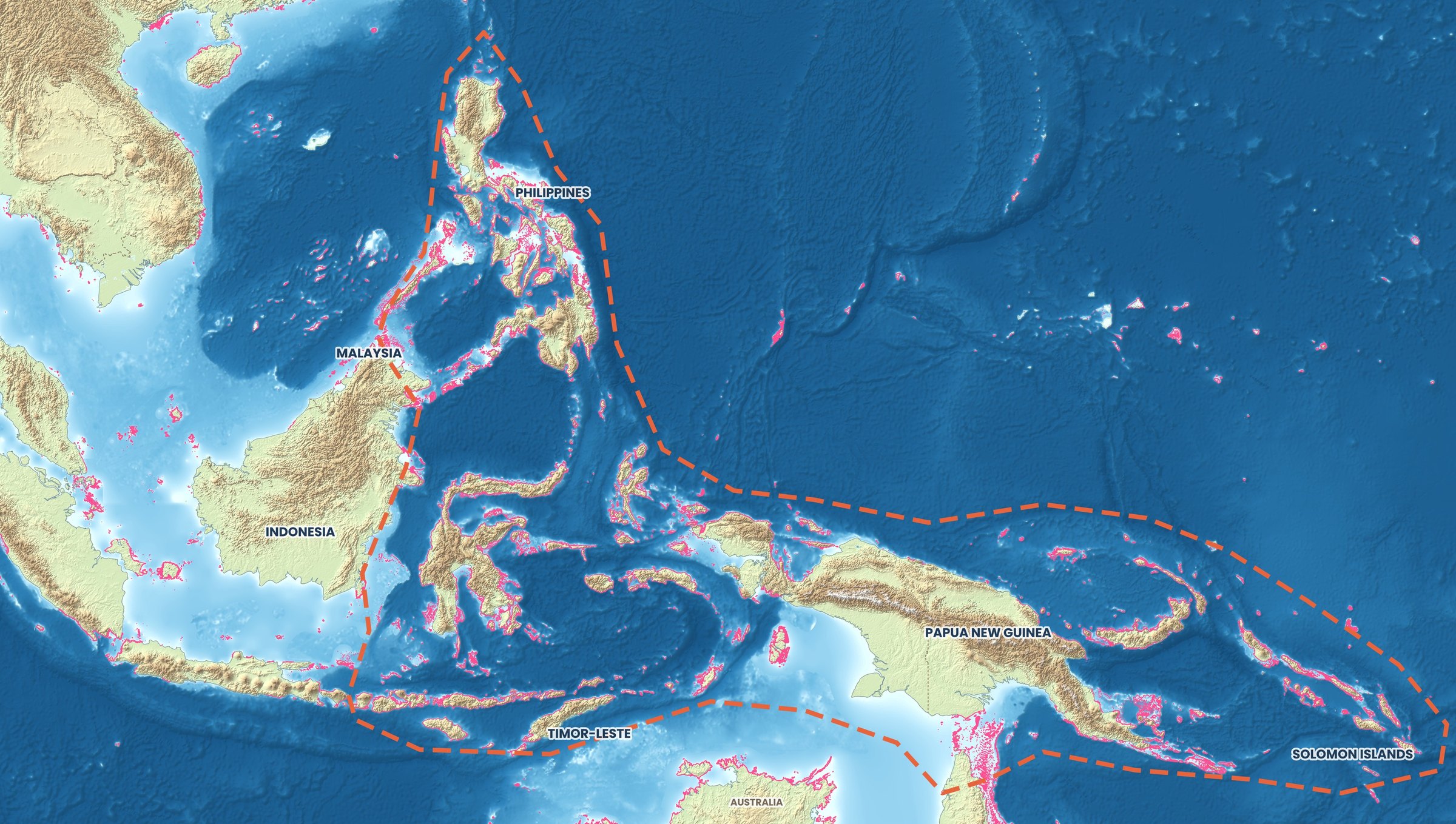
One is the largest coral reef system on Earth, protected as a single marine park off Queensland. The other is a sea region across six countries that holds three-quarters of the world's reef-building coral species. They are often mentioned in the same breath, but they are very different places to dive. Here is how they compare on size, species, reef health and the experience in the water.
What is the difference between the Coral Triangle and the Great Barrier Reef?
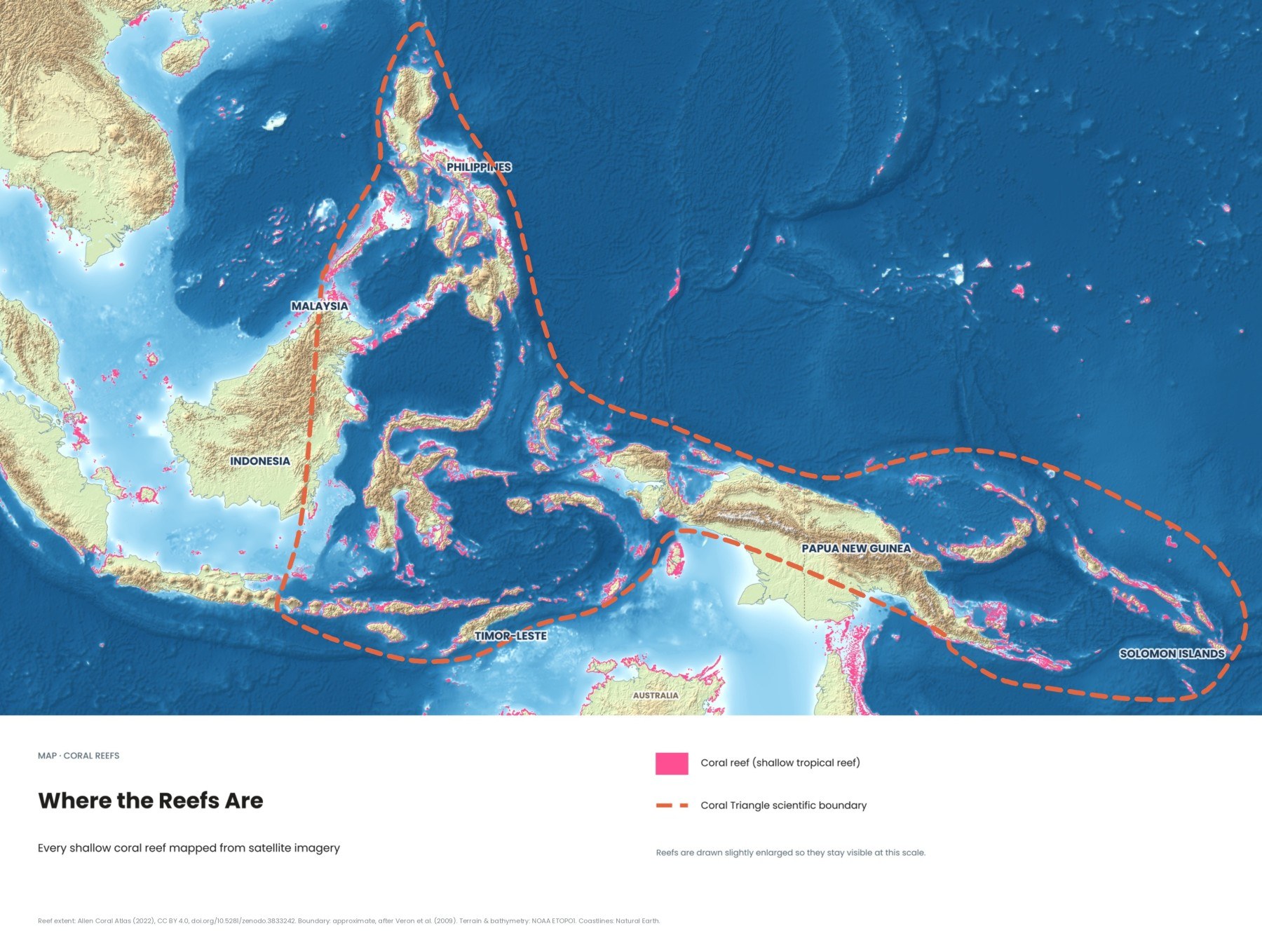
The Great Barrier Reef is one reef system in one country: about 3,000 reefs stretching some 2,300 kilometres along the coast of Queensland, Australia. The Coral Triangle is a whole sea region of about six million square kilometres shared by six countries, drawn around the waters with the highest coral diversity on the planet. One is the biggest reef; the other is the richest.
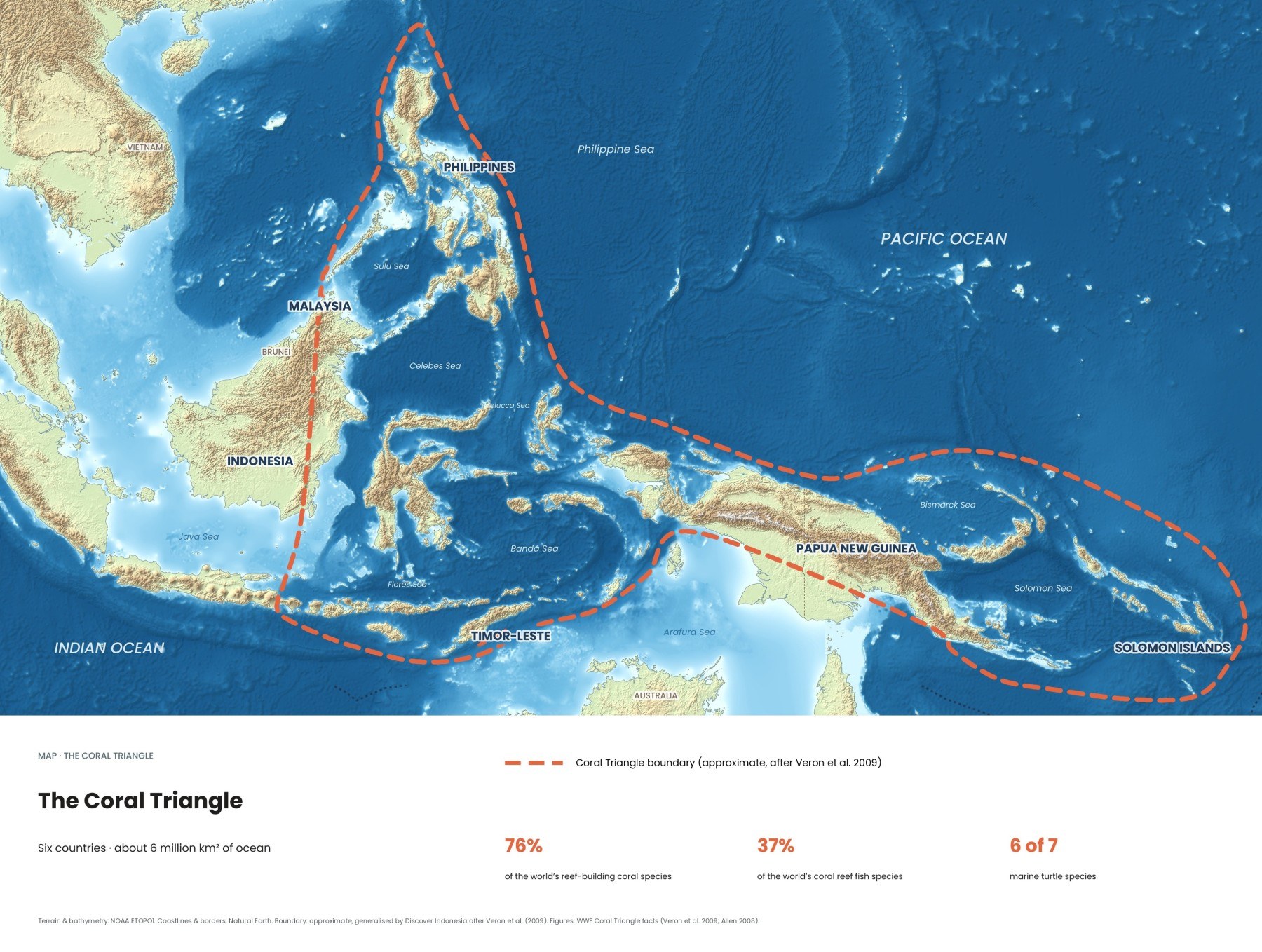
The Great Barrier Reef Marine Park covers 344,400 square kilometres and became a UNESCO World Heritage Site in 1981, though only around 7 percent of the park is actually coral reef. The Coral Triangle is a scientific boundary rather than a park, defined by where at least 500 species of reef-building coral occur. Indonesia holds the largest share, from Bali and the Lesser Sunda Islands to Raja Ampat and Papua.
Side by side
| Coral Triangle | Great Barrier Reef | |
|---|---|---|
| What it is | A sea region defined by coral diversity | A single reef system and marine park |
| Area | About 6 million km² of sea | 344,400 km² marine park |
| Countries | 6 | 1 (Australia) |
| Coral species | 605 reef-building species, 76% of the world's 798 | 450 hard corals, plus at least 1,000 soft corals and sea pens |
| Fish species | 2,228 reef fish, 37% of the world's reef fish | 1,625 fish species in total |
| Marine turtles | 6 of the world's 7 species | 6 of the world's 7 species |
| People | More than 100 million depend on its seas | A thinly populated coast; more than 70 Traditional Owner groups |
| Protection | Hundreds of separate parks under six governments | One marine park under one authority |
Read the fish row carefully: the Coral Triangle figure counts reef fish only, while the Great Barrier Reef figure counts every fish species in the park, including open-water and deep-water fish. Even so, the Triangle comes out well ahead, with a far wider mix of habitats, from mangroves and seagrass to volcanic black sand and deep walls.
Which has more coral and more fish?
The Coral Triangle, by a wide margin. WWF counts 605 reef-building coral species there, 76 percent of all known species, against 450 hard corals on the Great Barrier Reef, and 2,228 reef fish species. The Bird's Head Peninsula of West Papua alone holds 574 coral species and the Raja Ampat archipelago 553: a single Indonesian archipelago has more coral species than the entire Great Barrier Reef.
In the water this means variety rather than size. On a Raja Ampat or Komodo reef you see more kinds of things in one dive: more coral shapes, more small fish, more unusual invertebrates. On the Great Barrier Reef the reefs are vast and continuous, and the outer reefs have a clean, open-ocean feel. Our Raja Ampat dive guide shows the richest corner of the Triangle site by site.
Why is the Coral Triangle so rich?
Scientists still debate it. Species may have evolved here and spread outward, Indian and Pacific Ocean species overlap here, and larvae from across the region drift in and accumulate; most likely all three contribute. Indonesia's islands also create a huge range of conditions within short distances: sheltered bays next to exposed headlands, muddy river mouths next to clear oceanic walls, warm shallows next to cold upwelling. Each niche supports its own species.
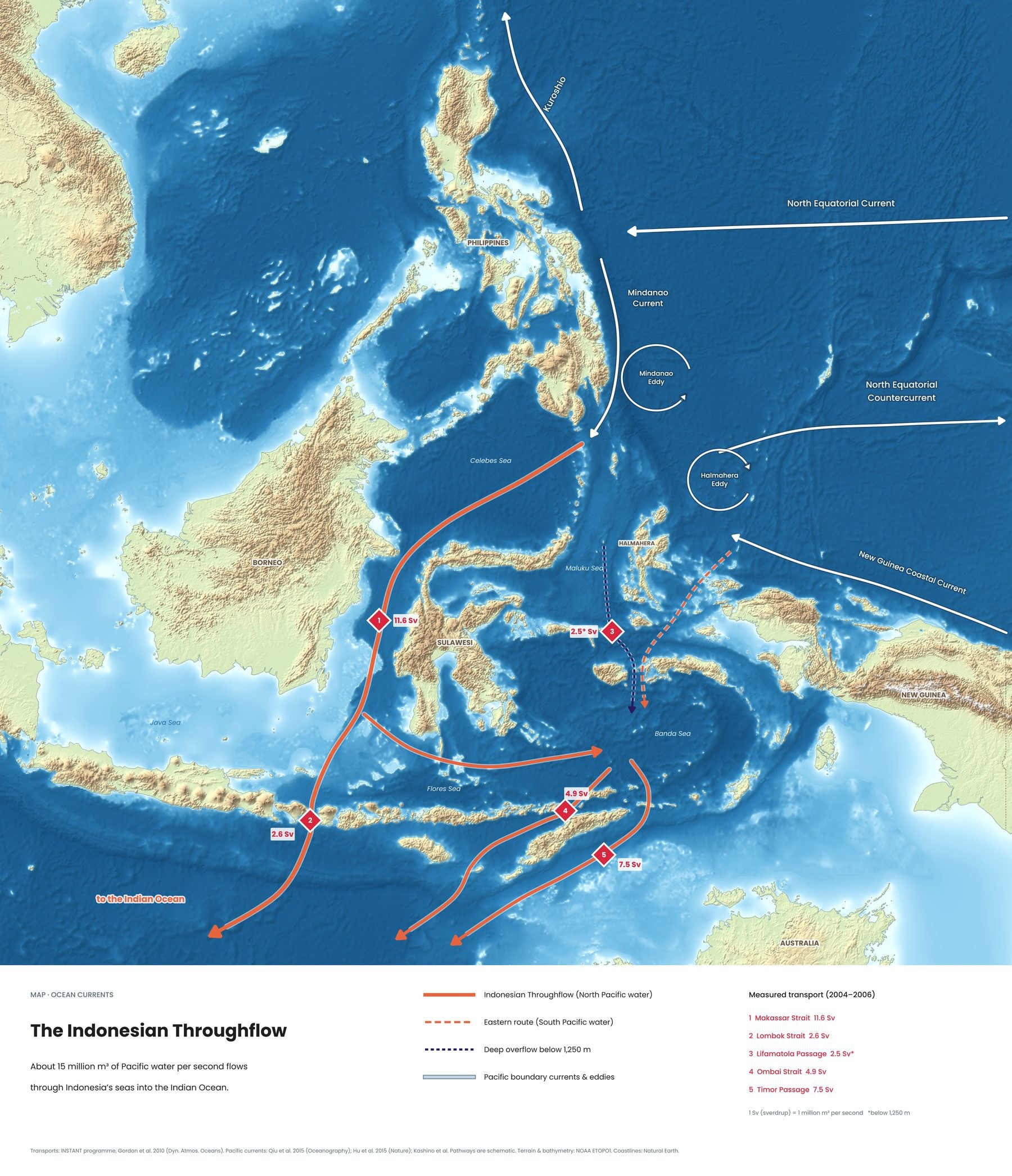
Then there is the water. The Indonesian Throughflow, which carries Pacific water through Indonesia's straits to the Indian Ocean, runs straight through the Coral Triangle, bringing nutrients and moving larvae from one reef system to the next. Read more about the Indonesian Throughflow →
How healthy are the reefs in 2026?
Both are under real pressure from warming seas. The Great Barrier Reef suffered its worst year of coral loss on record after the 2024 bleaching, then showed partial recovery in the north and centre in 2026. In the Coral Triangle the picture is patchier: the 2024 heatwave hit parts of the Pacific side hard, while many reefs in central and eastern Indonesia stayed below the bleaching alert level that year.
On the Great Barrier Reef, AIMS recorded hard coral cover falling by 30.6 percent in the southern reef in 2025, the largest annual decline recorded there. Its August 2026 report found northern cover back up to 35.1 percent and central to 31.6 percent, while the south held at around 26 percent. Category 5 Cyclone Narelle damaged reefs between Cairns and Lizard Island in March 2026.
The Coral Triangle also carries the pressure of a large coastal population: overfishing, coastal development, river sediment, plastic and oil from busy shipping lanes. Its protection is a patchwork of hundreds of parks, some with little enforcement. The upside is resilience in numbers: damaged reefs can be reseeded from healthy ones nearby, provided local pressure is kept low. The 2024 heatwave, on one map → · Marine protected areas, mapped → · Oil slicks from space →
Which is better for diving?
It depends on what you want. The Great Barrier Reef is better for easy, highly organised trips, strict regulation and big, continuous reefs within a day's boat ride, mostly from Cairns and the Whitsundays. Box jellyfish and the tiny Irukandji occur in Queensland's tropical waters, so wear the stinger suit operators hand out, especially in the warmer months. The Coral Triangle, and Indonesia in particular, is better for sheer variety: more species per dive, big animals in current, extraordinary small creatures, and reefs where you rarely see another boat.
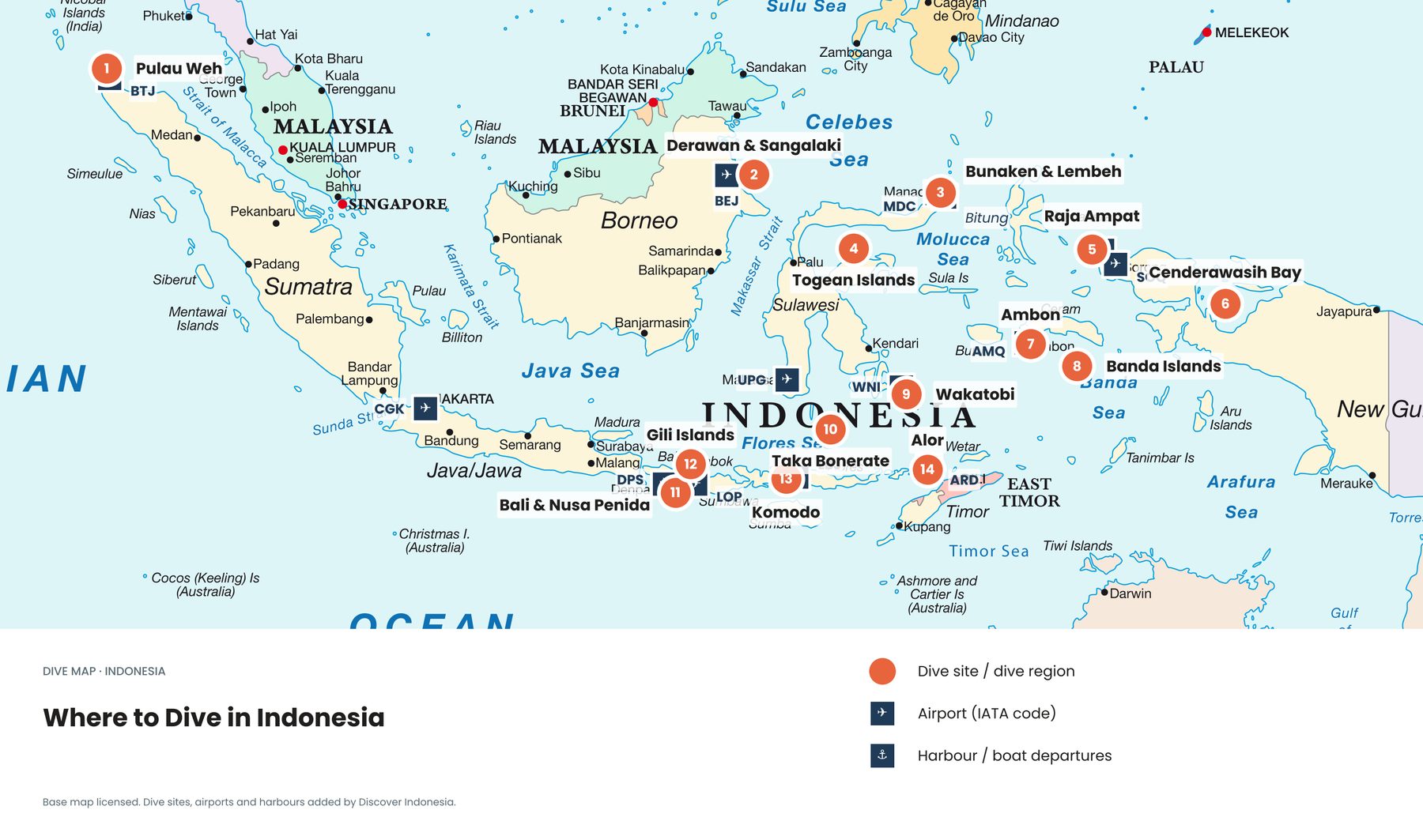
Indonesia is not one destination but a dozen: Raja Ampat for the richest reefs on Earth, Komodo for currents and mantas, North Sulawesi for Lembeh's muck diving and Bunaken's walls, Wakatobi for quiet, well-protected reefs, Bali and Nusa Penida as the easiest entry point, and Alor for cold, clear water. The trade-off is logistics: domestic flights, boat transfers and operator standards that vary more than in Australia.
Which is better for snorkelling and for beginners?
Both are excellent for snorkelling. The Great Barrier Reef offers well-organised trips to pontoons on the outer reef, some distance offshore. In Indonesia the reef is often right off the beach or jetty, at Raja Ampat's homestays, Pemuteran and Menjangan in Bali, or Manta Point in Komodo, so you can snorkel in soft early or late light when the boats are gone.
For a first dive or course, the Great Barrier Reef is the simpler choice: calm sites and strict safety rules. Many of Indonesia's famous sites, at Komodo, Nusa Penida and Alor, are current dives for experienced divers only. If you learn in Indonesia, start at Tulamben, Amed or Menjangan, Bunaken's walls or central Komodo's sheltered sites, and save Castle Rock or Toyapakeh until you have logged current dives with a good local guide.
Quick answers
Is the Great Barrier Reef part of the Coral Triangle?
No. It lies off northeastern Australia, south of the boundary, which ends at Papua New Guinea and the Solomon Islands. The two share many Indo-Pacific species, but the Great Barrier Reef has noticeably fewer.
Which is bigger?
As a single reef system, the Great Barrier Reef. As a region, the Coral Triangle covers roughly 17 times the area of the Great Barrier Reef Marine Park.
Can you see both on one trip?
Yes, if you have two to three weeks: a week or more in Indonesia, a few days on the Great Barrier Reef, and travel days in between. Check current flight routes when you plan.
Our Discover Indonesia guides to the Coral Triangle and to diving in Indonesia cover regions and planning in more depth. For a shortlist, see the ten best places to see the Coral Triangle, or browse all our guides.
Facts checked October 2026. Reef condition changes year to year; for the latest, check the Great Barrier Reef Marine Park Authority's Reef snapshot and the AIMS annual condition summary, and ask Indonesian park authorities or your dive operator about local conditions.
- Reef facts (Great Barrier Reef Marine Park Authority)
- Coral bleaching (Great Barrier Reef Marine Park Authority)
- End of summer snapshot reveals varied pressures, 2026 (Great Barrier Reef Marine Park Authority)
- GBR condition summary 2024-25 (Australian Institute of Marine Science)
- GBR condition summary 2025-26 (Australian Institute of Marine Science)
- Great Barrier Reef (UNESCO World Heritage Centre)
- Coral Triangle facts (WWF)
- Coral Triangle (Wikipedia)
- Maps: boundary approximate, generalised by Discover Indonesia after Veron et al. (2009); reef data from Allen Coral Atlas, CC BY 4.0; terrain NOAA ETOPO1